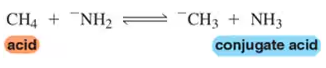
Using qualitative reasoning for the acid–base reactions shown, (i) which is stronger, the acid or the conjugate acid? (ii) Which side of the reaction is favored? (iii) Would you expect a Keq greater than, equal to, or less than 1? (b)
Verified step by step guidance
1
Step 1: Identify the acid and conjugate acid in the reaction. In the given reaction, CH₄ is labeled as the acid, and NH₃ is labeled as the conjugate acid. The acid donates a proton, while the conjugate acid is the product formed after the base accepts a proton.
Step 2: Compare the relative acid strengths of CH₄ and NH₃. Methane (CH₄) is a very weak acid because its C-H bond is highly stable and does not readily donate a proton. Ammonia (NH₃), on the other hand, is a stronger acid compared to CH₄, as it can donate a proton more readily.
Step 3: Determine which side of the reaction is favored. Since CH₄ is a weaker acid and NH₃ is a stronger acid, the equilibrium will favor the side with the weaker acid and weaker base. Therefore, the reaction is likely to favor the reactants (CH₄ and NH₂⁻).
Step 4: Analyze the equilibrium constant qualitatively. The equilibrium constant (K_eq) for this reaction would be less than 1 because the reactants are favored over the products due to the relative weakness of CH₄ as an acid.
Step 5: Summarize the reasoning. The acid (CH₄) is weaker than the conjugate acid (NH₃), the reaction favors the reactants, and the equilibrium constant is expected to be less than 1.
Verified video answer for a similar problem:
This video solution was recommended by our tutors as helpful for the problem above
Play a video:
0 Comments
Key Concepts
Here are the essential concepts you must grasp in order to answer the question correctly.
Acid-Base Theory
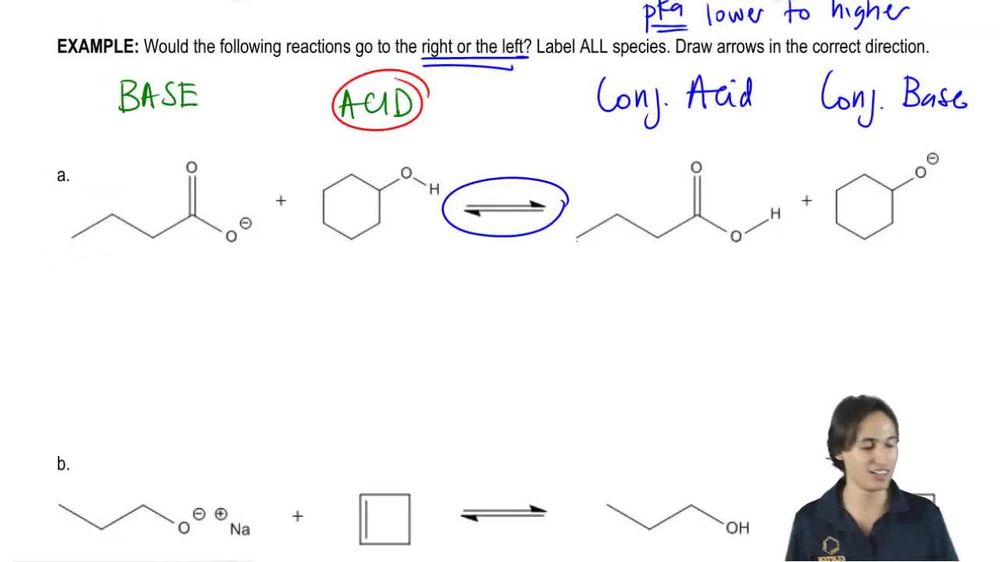
Acid-base theory explains the behavior of acids and bases in chemical reactions. According to the Brønsted-Lowry theory, an acid is a proton donor, while a base is a proton acceptor. In the given reaction, CH4 acts as an acid by donating a proton to the base NH2-, forming its conjugate base CH3- and the conjugate acid NH3.
Conjugate acid-base pairs consist of two species that differ by the presence of a proton. When an acid donates a proton, it forms its conjugate base, while the base that accepts the proton forms its conjugate acid. Understanding these pairs is crucial for predicting the direction of acid-base reactions and determining which species is stronger in a given context.
In acid-base reactions, the position of equilibrium indicates which side of the reaction is favored. The stronger acid will donate a proton to the stronger base, leading to the formation of the weaker acid and base. The equilibrium constant (K) can be used to quantify this favorability, where a value greater than 1 suggests that the products are favored, while a value less than 1 indicates that the reactants are favored.

 Verified step by step guidance
 02:49
02:49