(a) Rank the following carbocations from least stable to most stable. (b) Which would you expect to form first? (c) Which would you expect to react most quickly with a bromide ion (Br⁻) ? [Carbocations, like radicals, are electron deficient.]
Verified step by step guidance
1
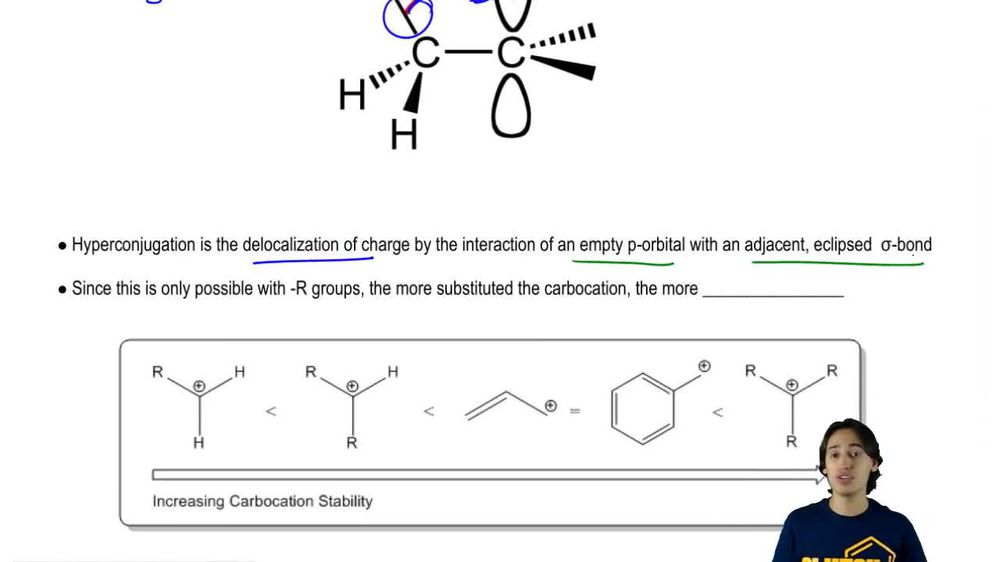
Step 1: Understand the stability of carbocations. Carbocation stability is influenced by factors such as the number of alkyl groups attached to the positively charged carbon (hyperconjugation), resonance stabilization, and inductive effects. Generally, tertiary carbocations are more stable than secondary, which are more stable than primary, and methyl carbocations are the least stable.
Step 2: Analyze the given carbocations and rank them based on their stability. Look for features such as the degree of substitution (primary, secondary, tertiary), resonance stabilization (if the positive charge is delocalized), and inductive effects from nearby electronegative atoms or groups.
Step 3: Determine which carbocation would form first. The formation of a carbocation depends on the energy required to generate it. The most stable carbocation typically forms first because it requires less energy to stabilize the positive charge.
Step 4: Predict which carbocation would react most quickly with a bromide ion (Br⁻). The reactivity of a carbocation with a nucleophile like Br⁻ is influenced by its stability. Less stable carbocations are more reactive because they are more eager to stabilize their positive charge by bonding with a nucleophile.
Step 5: Summarize the reasoning for each part of the problem. (a) Rank the carbocations based on stability using substitution, resonance, and inductive effects. (b) Identify the carbocation that forms first based on stability. (c) Determine the reactivity with Br⁻ based on the carbocation's eagerness to stabilize its charge.
Verified video answer for a similar problem:
This video solution was recommended by our tutors as helpful for the problem above
Video duration:
3m
Play a video:
0 Comments
Key Concepts
Here are the essential concepts you must grasp in order to answer the question correctly.
Carbocation Stability
Carbocation stability is influenced by the degree of alkyl substitution. Tertiary carbocations, which have three alkyl groups attached, are more stable than secondary and primary carbocations due to hyperconjugation and inductive effects. The presence of electron-donating groups helps to stabilize the positive charge, making tertiary carbocations the most stable.
Understanding the reaction mechanism is crucial for predicting the order of formation and reactivity of carbocations. The formation of a carbocation typically occurs through the loss of a leaving group or protonation of an alkene. The more stable the carbocation, the faster it will form and react, as it is lower in energy and more favorable.
Nucleophilic attack refers to the reaction of a nucleophile, such as bromide ion (Br⁻), with an electrophile, like a carbocation. The stability of the carbocation affects the rate of this reaction; more stable carbocations are more reactive towards nucleophiles. Thus, the carbocation that forms first and is most stable will react most quickly with Br⁻.

 3:27 minutes
 Verified step by step guidance
 05:58
05:58