Based on the absolute configuration of (S)-butan-2-ol, what can you say about the direction it rotates plane-polarized light?
Verified step by step guidance
1
Step 1: Understand the relationship between absolute configuration and optical activity. The absolute configuration (R or S) of a chiral molecule does not directly determine the direction (dextrorotatory or levorotatory) in which it rotates plane-polarized light.
Step 2: Recall that the direction of rotation of plane-polarized light (optical activity) is an experimental property and is denoted as (+) for dextrorotatory (clockwise) or (-) for levorotatory (counterclockwise). This property must be determined experimentally.
Step 3: Note that (S)-butan-2-ol has the absolute configuration 'S', but this does not imply whether it is (+) or (-). For example, (S)-butan-2-ol is known to rotate plane-polarized light in the counterclockwise direction, making it levorotatory (-).
Step 4: Emphasize that the correlation between absolute configuration and optical rotation is specific to each compound and cannot be generalized. Experimental data is required to determine the optical rotation.
Step 5: Conclude that while the absolute configuration of (S)-butan-2-ol is known, its optical rotation direction (counterclockwise, or levorotatory) must be experimentally verified and is not inherently linked to the 'S' configuration.
Verified video answer for a similar problem:
This video solution was recommended by our tutors as helpful for the problem above
Video duration:
1m
Play a video:
0 Comments
Key Concepts
Here are the essential concepts you must grasp in order to answer the question correctly.
Optical Activity
Optical activity refers to the ability of chiral compounds to rotate the plane of polarized light. This property arises from the asymmetry in the molecular structure, which allows chiral molecules to interact differently with light. The direction of rotation can be either clockwise (dextrorotatory) or counterclockwise (levorotatory), and is denoted by the symbols '+' or '−'.
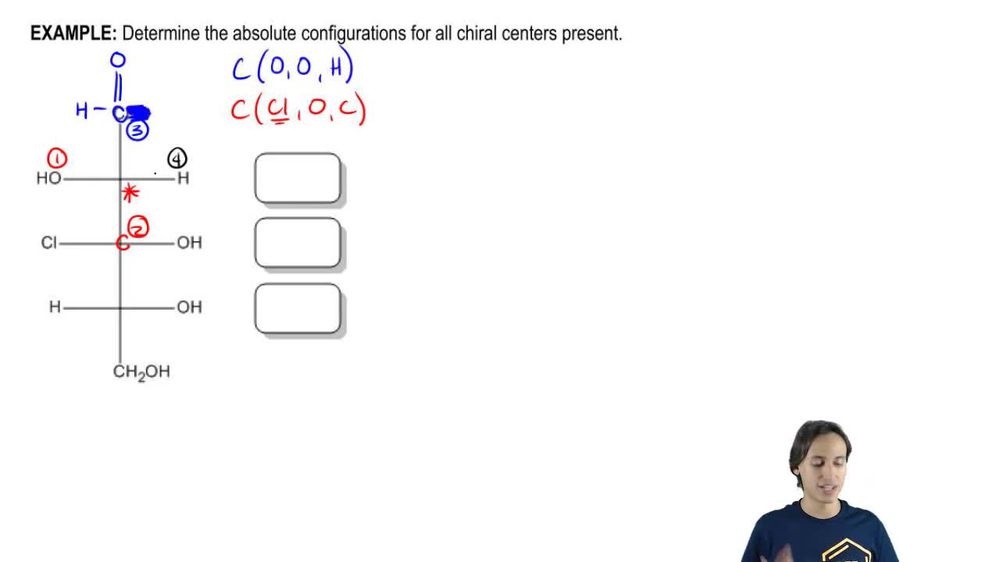
Absolute configuration describes the spatial arrangement of atoms in a chiral molecule, designated as either 'R' (rectus) or 'S' (sinister) based on the Cahn-Ingold-Prelog priority rules. For (S)-butan-2-ol, the 'S' configuration indicates a specific three-dimensional arrangement of its substituents around the chiral center, which influences its optical activity.
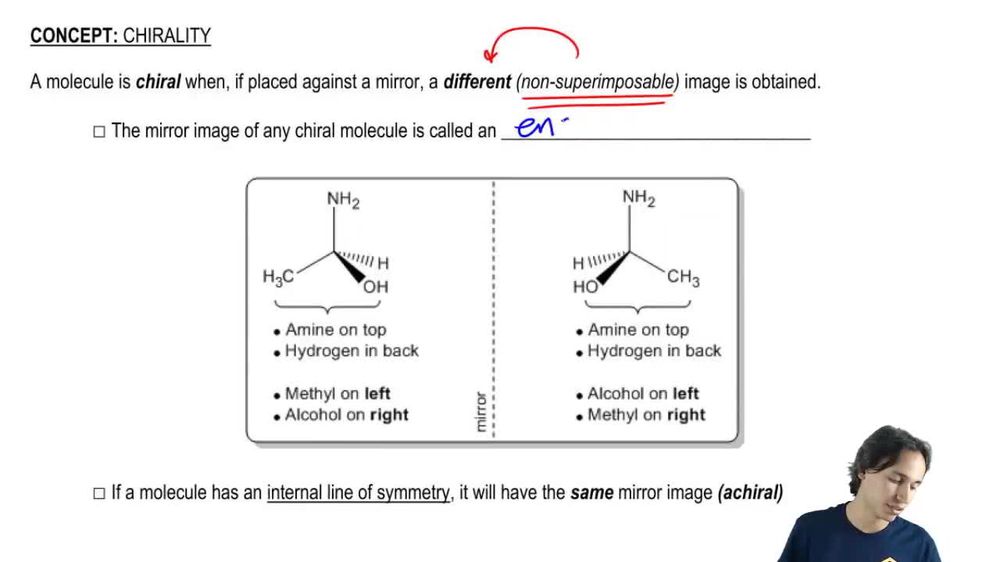
Chirality is a property of a molecule that makes it non-superimposable on its mirror image, leading to the existence of stereoisomers. These stereoisomers, such as (R)- and (S)- forms of butan-2-ol, can exhibit different physical properties, including the direction in which they rotate polarized light. Understanding chirality is crucial for predicting the behavior of organic compounds in optical activity.

 1:47 minutes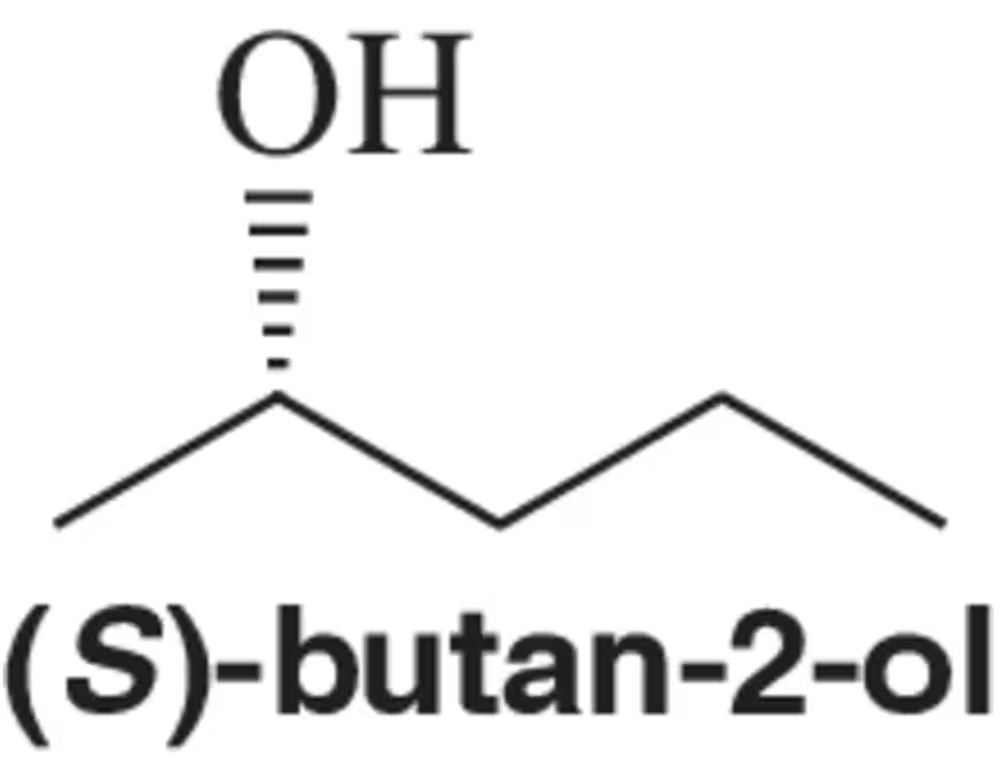
 Verified step by step guidance
 08:17
08:17