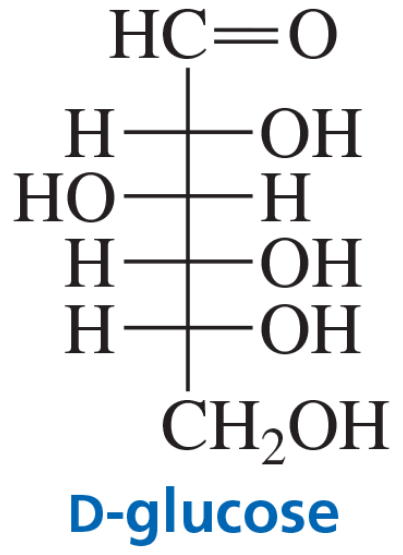
A student decided that the configuration of the asymmetric centers in a sugar such as D-glucose could be determined rapidly by simply assigning the R configuration to an symmetric center with an OH group on the right and the S configuration to an symmetric center with an OH group on the left. Is he correct?
Verified step by step guidance
1
Step 1: Understand the problem. The student is proposing a simplified method to assign R and S configurations to asymmetric centers in D-glucose based on the position of the OH group (right = R, left = S). We need to evaluate whether this approach is correct.
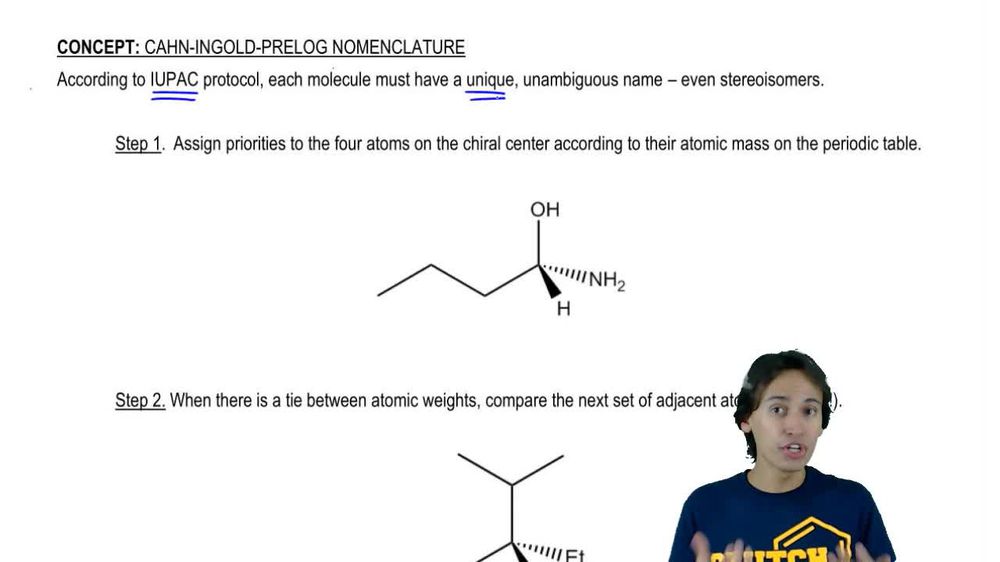
Step 2: Recall the rules for assigning R and S configurations. The Cahn-Ingold-Prelog priority rules are used to determine the configuration of a chiral center. These rules involve assigning priorities to substituents based on atomic number and arranging the molecule so the lowest priority group is pointing away from the observer.
Step 3: Analyze the structure of D-glucose. D-glucose has four asymmetric centers (chiral carbons). The OH groups are positioned on either the right or left side in the Fischer projection. However, the Fischer projection does not directly indicate the spatial arrangement required for R/S determination.
Step 4: Explain why the student's method is incorrect. The configuration (R or S) of a chiral center depends on the 3D spatial arrangement of the substituents, not simply their position in a 2D Fischer projection. The position of the OH group (right or left) in the Fischer projection does not guarantee the correct R/S assignment without applying the priority rules and visualizing the molecule in 3D.
Step 5: Conclude that the student’s method oversimplifies the process and does not account for the necessary application of the Cahn-Ingold-Prelog rules. To correctly assign R and S configurations, the molecule must be analyzed in 3D, and the priorities of all substituents must be considered.
Verified video answer for a similar problem:

This video solution was recommended by our tutors as helpful for the problem above
Video duration:
7m
Play a video:
0 Comments
Key Concepts
Here are the essential concepts you must grasp in order to answer the question correctly.
Asymmetric Centers
Asymmetric centers, or chiral centers, are carbon atoms bonded to four different substituents, leading to non-superimposable mirror images known as enantiomers. In sugars like d-glucose, the configuration at these centers is crucial for determining the molecule's stereochemistry and biological activity. Understanding how to identify and assign configurations at these centers is essential for analyzing sugar structures.
The Cahn-Ingold-Prelog (CIP) priority rules are a systematic method for assigning R (rectus) and S (sinister) configurations to chiral centers. These rules dictate that substituents are ranked based on atomic number, with higher atomic numbers receiving higher priority. This systematic approach is necessary to accurately determine the stereochemistry of asymmetric centers, rather than relying on the position of functional groups alone.
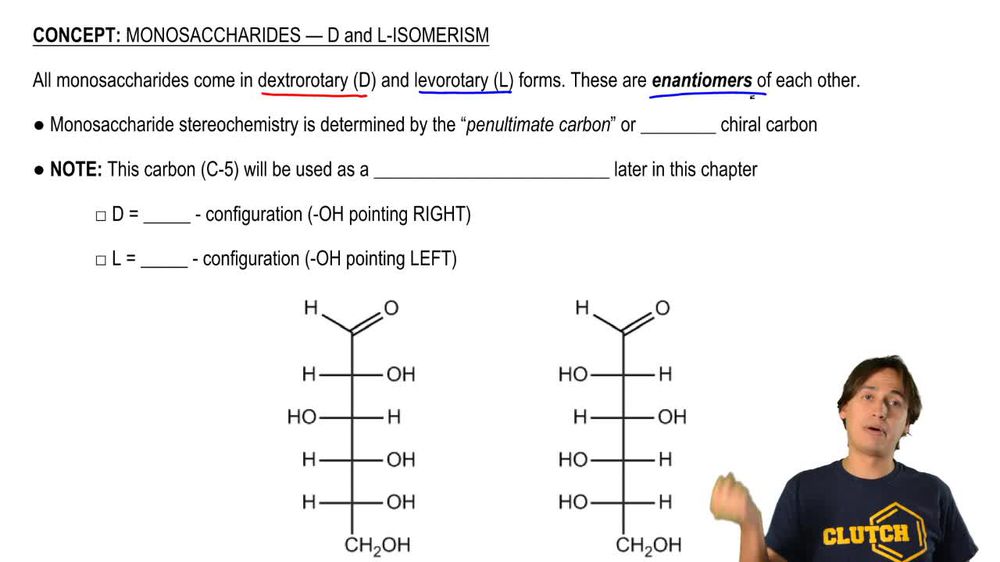
The D- and L- notation in sugars refers to the configuration of the asymmetric carbon farthest from the aldehyde or ketone group. In d-glucose, the D- configuration indicates that the hydroxyl group on this carbon is on the right in a Fischer projection. This notation is essential for distinguishing between different sugar isomers and understanding their biochemical roles, making it important for the student's analysis of d-glucose.