Point out the flaws in the following incorrect Grignard syntheses. (a)
Verified step by step guidance
1
Step 1: Analyze the starting material in the reaction. In part (a), the starting material is a brominated amine (a bromocyclohexylamine). The presence of the amine group (-NH) is problematic for Grignard reagent formation because amines are nucleophilic and can react with the Grignard reagent, leading to side reactions.
Step 2: Understand the conditions for Grignard reagent formation. Grignard reagents are formed by reacting an alkyl halide with magnesium in an ether solvent. However, functional groups like -NH can interfere by protonating the Grignard reagent, rendering it inactive.
Step 3: Consider the reaction mechanism. The Grignard reagent (R-MgX) is highly reactive and requires an inert environment. The amine group in the starting material can act as a proton donor, quenching the Grignard reagent before it can react with the aldehyde (Ph-CHO).
Step 4: Evaluate the product formation. The desired product involves the addition of the Grignard reagent to the aldehyde, followed by hydrolysis. However, due to the interference of the amine group, the Grignard reagent cannot form properly, and the reaction fails.
Step 5: Suggest corrections. To successfully perform this synthesis, the amine group must be protected or removed before attempting Grignard reagent formation. Alternatively, a different synthetic route that avoids the use of a Grignard reagent could be considered.
Verified video answer for a similar problem:
This video solution was recommended by our tutors as helpful for the problem above
Video duration:
6m
Play a video:
0 Comments
Key Concepts
Here are the essential concepts you must grasp in order to answer the question correctly.
Grignard Reagents
Grignard reagents are organomagnesium compounds formed by the reaction of magnesium with alkyl or aryl halides. They are highly reactive nucleophiles used in organic synthesis to form carbon-carbon bonds. In the context of the question, the formation of a Grignard reagent from the given brominated compound is essential for the subsequent reaction with an aldehyde.
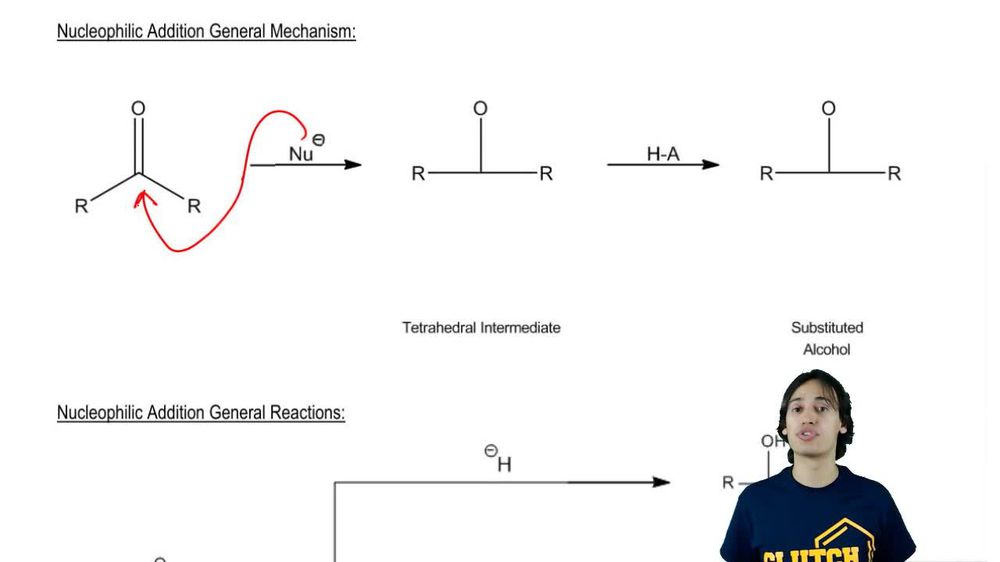
Nucleophilic addition is a fundamental reaction mechanism in organic chemistry where a nucleophile attacks an electrophilic carbon atom, typically in carbonyl compounds like aldehydes and ketones. In the provided synthesis, the Grignard reagent should add to the carbonyl carbon of the aldehyde, leading to the formation of an alcohol after hydrolysis. Understanding this mechanism is crucial to identify flaws in the proposed synthesis.
Functional group compatibility refers to the ability of different functional groups to coexist and react without interfering with each other. In the case of the incorrect Grignard synthesis, the presence of the nitrogen atom in the starting material can lead to complications, as Grignard reagents are sensitive to protic functional groups, which can result in side reactions or the failure of the intended reaction. Recognizing these compatibility issues is key to evaluating the synthesis.

 6:30 minutes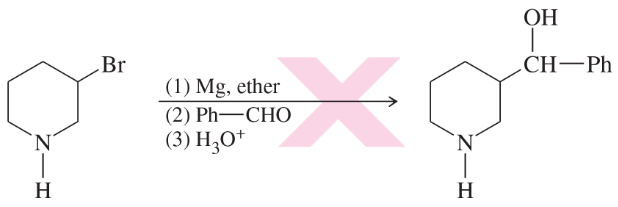
 Verified step by step guidance
 02:12
02:12