Rank the following carbocations in each set from most stable to least stable: b.
Verified step by step guidance
1
Step 1: Analyze the stability of each carbocation based on inductive effects. Electron-donating groups (EDGs) stabilize carbocations by donating electron density, while electron-withdrawing groups (EWGs) destabilize carbocations by pulling electron density away.
Step 2: Examine the substituents attached to the carbon adjacent to the carbocation. In structure I, the hydroxyl group (-OH) is an electron-donating group via inductive and resonance effects, which stabilizes the carbocation. In structure II, the alkyl group (-CH3) is also an electron-donating group, but it stabilizes the carbocation only through inductive effects.
Step 3: Evaluate structure III, where the bromine atom (-Br) is an electron-withdrawing group due to its electronegativity. However, it can also donate electron density through resonance, providing partial stabilization to the carbocation. Compare this to structure IV, where the nitro group (-NO2) is a strongly electron-withdrawing group, destabilizing the carbocation significantly.
Step 4: Rank the carbocations based on the degree of stabilization provided by the substituents. The order of stability is determined by the balance of inductive and resonance effects. Structure I is the most stable due to the strong electron-donating effects of the hydroxyl group. Structure II follows, as the alkyl group provides moderate stabilization. Structure III is less stable due to the mixed effects of bromine, and structure IV is the least stable due to the destabilizing nitro group.
Step 5: Final ranking: I > II > III > IV. This ranking is based on the substituents' ability to stabilize the carbocation through inductive and resonance effects.
Verified video answer for a similar problem:
This video solution was recommended by our tutors as helpful for the problem above
Video duration:
4m
Play a video:
0 Comments
Key Concepts
Here are the essential concepts you must grasp in order to answer the question correctly.
Carbocation Stability
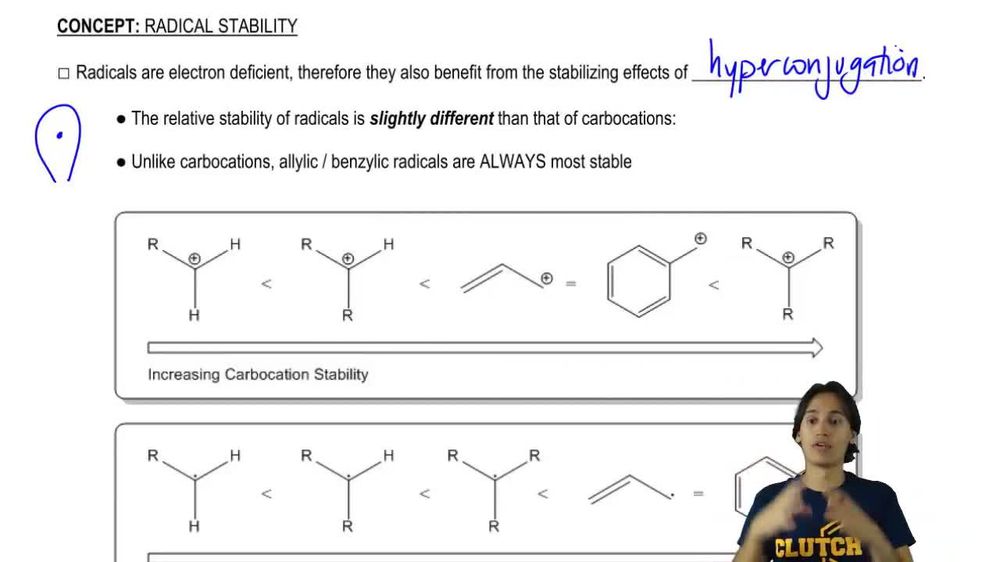
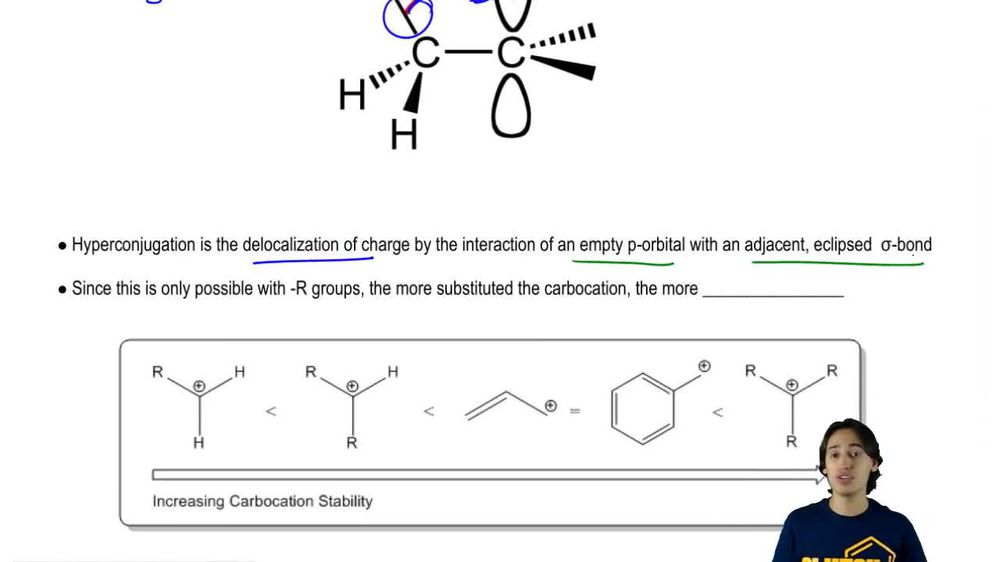
Carbocations are positively charged carbon species that are classified based on their stability. The stability order is tertiary > secondary > primary > methyl, primarily due to hyperconjugation and inductive effects. Tertiary carbocations are stabilized by three alkyl groups that donate electron density, while primary carbocations are less stable due to fewer electron-donating groups.
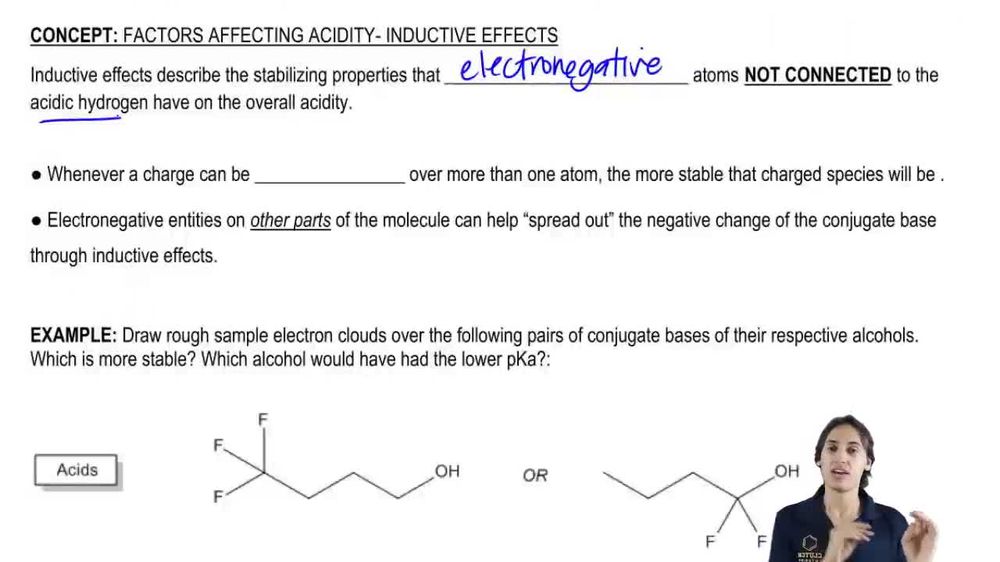
The inductive effect refers to the electron-withdrawing or electron-donating effects of substituents through sigma bonds. Electronegative atoms or groups, such as -NO2, can destabilize carbocations by pulling electron density away, making the carbocation less stable. Conversely, alkyl groups can stabilize carbocations by donating electron density through the inductive effect.
Resonance stabilization occurs when a carbocation can delocalize its positive charge over multiple atoms through pi bonds or lone pairs. This delocalization lowers the energy of the carbocation, enhancing its stability. For example, a carbocation adjacent to a double bond or an aromatic ring can be significantly more stable due to resonance compared to one without such features.