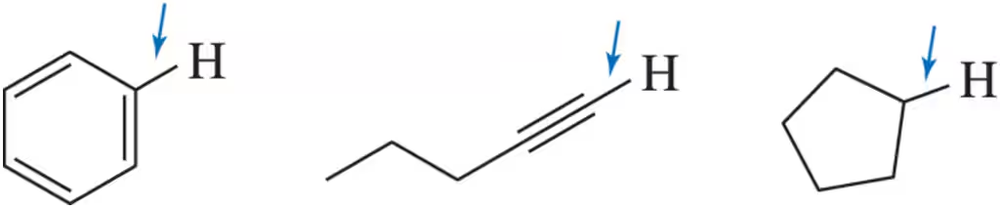
Rank C―H σ the following bonds in terms of their bond length. Explain your ranking ( 1= longest ; 3 = shortest).
Verified step by step guidance
1
Step 1: Understand the relationship between bond length and hybridization. Bond length is influenced by the hybridization of the carbon atom bonded to hydrogen. The more s-character in the hybrid orbital, the shorter the bond length. For example, sp hybridized carbons have the shortest bond length, followed by sp2, and then sp3 hybridized carbons.
Step 2: Analyze the structures provided. The first structure is a benzene ring with an sp2 hybridized carbon bonded to hydrogen. The second structure is a terminal alkyne with an sp hybridized carbon bonded to hydrogen. The third structure is a cyclopentane ring with an sp3 hybridized carbon bonded to hydrogen.
Step 3: Compare the hybridization of the carbon atoms. The sp hybridized carbon in the alkyne has the highest s-character (50%), resulting in the shortest bond length. The sp2 hybridized carbon in the benzene ring has intermediate s-character (33%), resulting in a bond length longer than sp but shorter than sp3. The sp3 hybridized carbon in cyclopentane has the lowest s-character (25%), resulting in the longest bond length.
Step 4: Rank the bond lengths based on the hybridization. The bond length ranking is as follows: (1) Cyclopentane (sp3, longest bond length), (2) Benzene (sp2, intermediate bond length), (3) Terminal alkyne (sp, shortest bond length).
Step 5: Summarize the reasoning. The bond length decreases as the s-character of the hybrid orbital increases. This is because orbitals with higher s-character are closer to the nucleus, pulling the bonded atoms closer together and shortening the bond length.
Verified video answer for a similar problem:
This video solution was recommended by our tutors as helpful for the problem above
Play a video:
0 Comments
Key Concepts
Here are the essential concepts you must grasp in order to answer the question correctly.
Bond Length
Bond length is the distance between the nuclei of two bonded atoms. It is influenced by the size of the atoms involved and the type of bond (single, double, or triple). Generally, as the number of shared electron pairs increases, the bond length decreases due to stronger attraction between the nuclei and the shared electrons.
σ (sigma) bonds are the strongest type of covalent bond formed by the head-on overlap of atomic orbitals. They are characterized by a cylindrical symmetry around the bond axis and are typically formed between s and p orbitals. The presence of σ bonds in a molecule significantly affects its geometry and stability, influencing the overall bond length.
Several factors influence bond length, including atomic size, electronegativity, and hybridization. Larger atoms tend to form longer bonds due to increased distance between nuclei. Additionally, differences in electronegativity can lead to variations in bond character, while hybridization can affect the spatial orientation of orbitals, further impacting bond lengths.

 Verified step by step guidance
 06:00
06:00