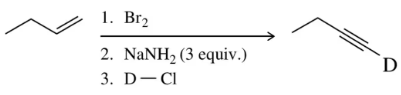
When the reaction scheme in Assessment 12.63 is done on a monosubstituted alkene, at least three equivalents of base are needed. Reacting the product of step 2 with D–Cl (D is an isotope of H) incorporates deuterium at the terminal carbon. Explain these two observations.
Verified step by step guidance
1
Step 1: Analyze the reaction scheme. The first step involves the addition of Br2 to the monosubstituted alkene. This results in the formation of a vicinal dibromide (two bromine atoms added to adjacent carbons). This is a typical halogenation reaction of alkenes.
Step 2: Understand the role of NaNH2 (sodium amide). Sodium amide is a strong base, and three equivalents are required to perform successive elimination reactions. Each equivalent of NaNH2 removes one molecule of HBr, leading to the formation of a triple bond (alkyne) at the terminal position.
Step 3: Explain the need for three equivalents of base. The first two equivalents of NaNH2 are used to eliminate two molecules of HBr from the vicinal dibromide, forming the alkyne. The third equivalent is necessary to deprotonate the terminal alkyne, generating a carbanion at the terminal carbon.
Step 4: Describe the reaction with D–Cl. The carbanion formed at the terminal carbon is highly nucleophilic and reacts with D–Cl, leading to the incorporation of deuterium (D, an isotope of hydrogen) at the terminal carbon. This step replaces the acidic terminal hydrogen with deuterium.
Step 5: Summarize the observations. The need for three equivalents of base arises from the elimination of HBr and the deprotonation of the terminal alkyne. The incorporation of deuterium occurs because the terminal carbanion reacts with D–Cl, substituting the terminal hydrogen with deuterium.
Verified video answer for a similar problem:
This video solution was recommended by our tutors as helpful for the problem above
Video duration:
6m
Play a video:
0 Comments
Key Concepts
Here are the essential concepts you must grasp in order to answer the question correctly.
Monosubstituted Alkenes
Monosubstituted alkenes are alkenes that have one substituent group attached to the double bond. This structure influences the reactivity of the alkene, particularly in elimination reactions where a base is required to abstract a proton. The presence of a substituent can stabilize the resulting alkene or carbocation, affecting the number of equivalents of base needed for the reaction.
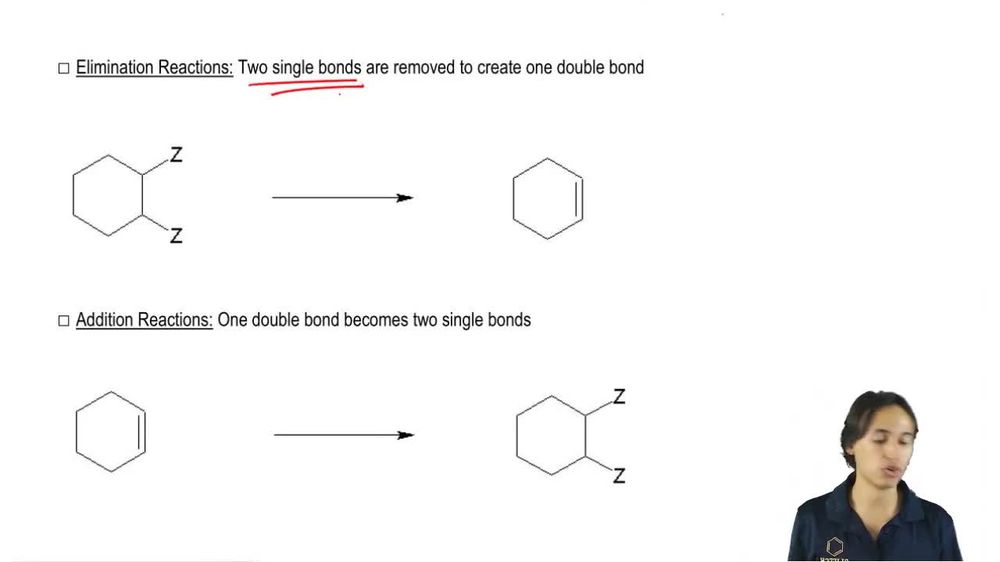
Elimination reactions involve the removal of atoms or groups from a molecule, typically resulting in the formation of a double bond. In the context of the question, the need for three equivalents of base suggests a multi-step elimination process, where the base first abstracts a proton, and subsequent steps may require additional base to facilitate further elimination or to stabilize intermediates.
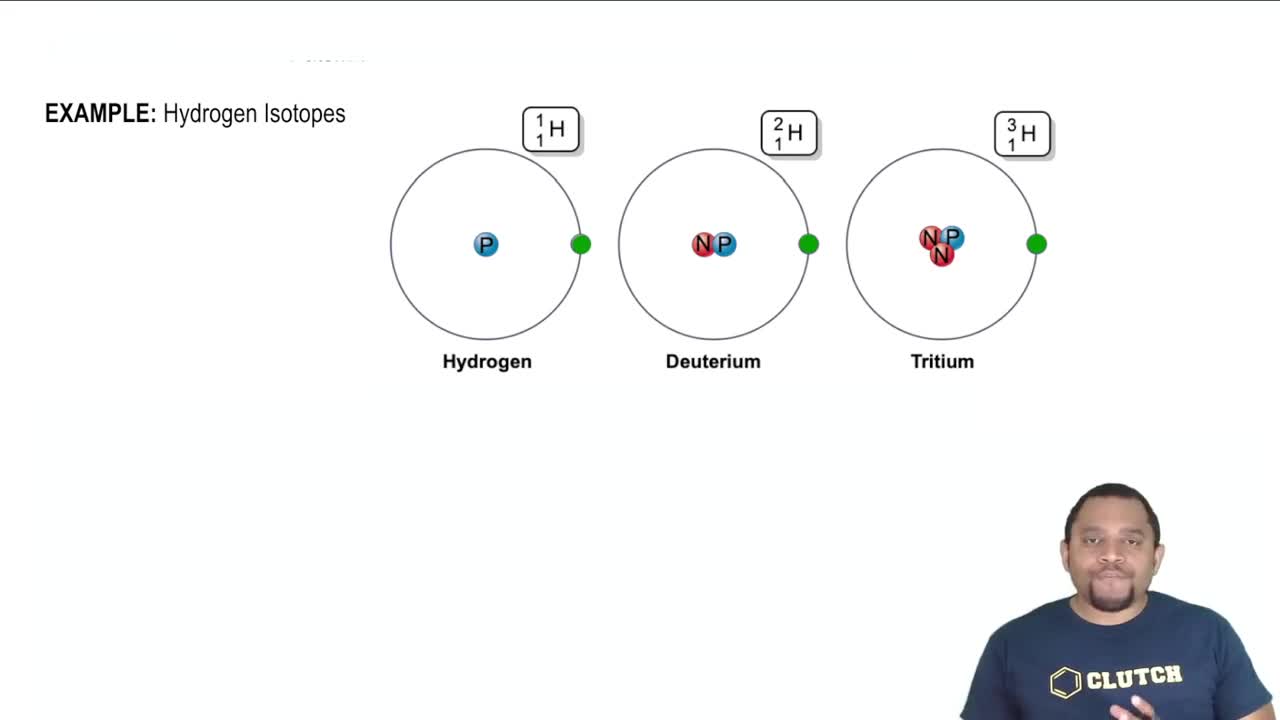
Deuterium incorporation refers to the introduction of the deuterium isotope (D) into a molecule, which can be tracked in reactions involving isotopes. In this case, the reaction with D-Cl indicates that the terminal carbon of the alkene is involved in the reaction mechanism, likely through a carbocation intermediate, allowing for the substitution of a hydrogen atom with deuterium at that position.