

Ch. 20 - Carboxylic Acids
Wade - Organic Chemistry 9th Edition
Wade9th EditionOrganic ChemistryISBN: 9780135213728Not the one you use?Change textbook
Chapter 20, Problem 41

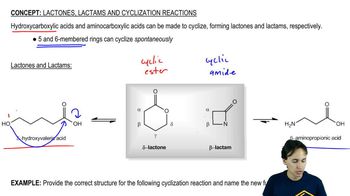
In the presence of a trace of acid, δ-hydroxyvaleric acid forms a cyclic ester (lactone).

(a) Give the structure of the lactone, called δ-valerolactone.
(b) Propose a mechanism for the formation of δ-valerolactone.

Verified step by step guidance
1
Step 1: Recognize that delta-hydroxyvaleric acid contains both a hydroxyl (-OH) group and a carboxylic acid (-COOH) group. In the presence of trace acid, these functional groups can interact to form a cyclic ester (lactone).
Step 2: Understand the reaction mechanism. The hydroxyl group acts as a nucleophile and attacks the carbonyl carbon of the carboxylic acid group. This intramolecular reaction leads to the formation of a five-membered ring structure.
Step 3: Protonation of the carboxylic acid group occurs first under acidic conditions, making the carbonyl carbon more electrophilic and susceptible to nucleophilic attack by the hydroxyl group.
Step 4: After the nucleophilic attack, a tetrahedral intermediate is formed. This intermediate undergoes elimination of water (dehydration), resulting in the formation of the cyclic ester (delta-valerolactone).
Step 5: The final structure of delta-valerolactone is a five-membered ring containing an ester functional group. The oxygen from the hydroxyl group is part of the ring, and the carbonyl group is retained as part of the ester.

Verified video answer for a similar problem:

This video solution was recommended by our tutors as helpful for the problem above.
Video duration:
10m
Was this helpful?

Key Concepts

Here are the essential concepts you must grasp in order to answer the question correctly.

Lactone Formation

Lactones are cyclic esters formed from the reaction of a hydroxy acid, where the hydroxyl group reacts with the carboxylic acid group to create a ring structure. This process typically occurs through a dehydration reaction, where water is eliminated, allowing the molecule to close into a cyclic form. In the case of delta-hydroxyvaleric acid, the formation of delta-valerolactone involves the intramolecular reaction of the hydroxyl group with the carboxylic acid group.
Recommended video:
Guided course
05:19
Lactones and Lactams

Acid-Catalyzed Reactions

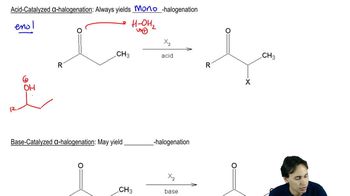
Acid-catalyzed reactions involve the use of an acid to increase the rate of a chemical reaction. In the context of lactone formation, the presence of a trace of acid can protonate the hydroxyl group, making it a better leaving group and facilitating the formation of the cyclic structure. This catalytic role is crucial in promoting the dehydration step necessary for lactone synthesis.
Recommended video:
Guided course
03:09
Acid Catalyzed

Mechanism of Esterification

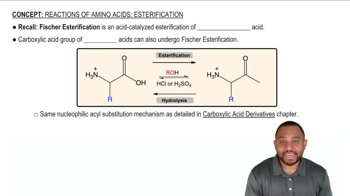
The mechanism of esterification describes the stepwise process through which an alcohol and a carboxylic acid react to form an ester. In the case of delta-valerolactone, the mechanism involves protonation of the hydroxyl group, nucleophilic attack by the hydroxyl on the carbonyl carbon, and subsequent elimination of water. Understanding this mechanism is essential for proposing a detailed pathway for the formation of the lactone from delta-hydroxyvaleric acid.
Recommended video:
1:21
Reactions of Amino Acids: Esterification Concept 1
Related Practice
Textbook Question

Two of the methods for converting alkyl halides to carboxylic acids are covered in Sections 20-8B and 20-8C. One is formation of a Grignard reagent followed by addition of carbon dioxide and then dilute acid. The other is substitution by cyanide ion, followed by hydrolysis of the resulting nitrile. For each of the following conversions, decide whether either or both of these methods would work, and explain why. Show the reactions you would use.

(a)

(b)

1817
views
Textbook Question

Peroxyacetic acid (bp = 105 °C) has a lower boiling point than acetic acid (bp = 118 °C), even though peroxyacetic acid has a higher molecular weight. Explain why peroxyacetic acid is more volatile than acetic acid.

796
views
Textbook Question

The following NMR spectra correspond to compound of formula (C) C6H10O2. Propose structure, and show how it is consistent with the observed absorptions.

<IMAGE>

3598
views
1
rank
Textbook Question

Show how you would accomplish the following multistep syntheses. You may use any additional reagents and solvents you need.

(f)

1112
views
Textbook Question

Two of the methods for converting alkyl halides to carboxylic acids are covered in Sections 20-8B and 20-8C. One is formation of a Grignard reagent followed by addition of carbon dioxide and then dilute acid. The other is substitution by cyanide ion, followed by hydrolysis of the resulting nitrile. For each of the following conversions, decide whether either or both of these methods would work, and explain why. Show the reactions you would use.

(e)

(f)

590
views
Textbook Question

The following NMR spectra correspond to compound of formula (A) C9H10O2. Propose structure, and show how it is consistent with the observed absorptions.

<IMAGE>

3777
views
1
rank