Predict the major products of the following reactions. (c) nitrobenzene + fuming sulfuric acid
Verified step by step guidance
1
Step 1: Analyze the reactants. Nitrobenzene (C6H5NO2) is an aromatic compound with a nitro group (-NO2) attached to the benzene ring. Fuming sulfuric acid is a mixture of sulfuric acid (H2SO4) and sulfur trioxide (SO3), which is used for sulfonation reactions.
Step 2: Understand the reaction mechanism. Sulfonation of aromatic compounds involves the electrophilic substitution of a hydrogen atom on the benzene ring with a sulfonic acid group (-SO3H). The nitro group (-NO2) is an electron-withdrawing group, which deactivates the benzene ring and directs incoming electrophiles to the meta position relative to itself.
Step 3: Predict the major product. Since the nitro group is meta-directing, the sulfonic acid group (-SO3H) will be introduced at the meta position relative to the nitro group on the benzene ring.
Step 4: Compare the provided options. Among the given structures (A, B, C, D), identify the one where the sulfonic acid group (-SO3H) is at the meta position relative to the nitro group (-NO2).
Step 5: Confirm the correct structure. Based on the sulfonation mechanism and the directing effects of the nitro group, the major product will be the structure where the -SO3H group is meta to the -NO2 group. This corresponds to option C in the provided image.
Verified video answer for a similar problem:
This video solution was recommended by our tutors as helpful for the problem above
Video duration:
6m
Play a video:
0 Comments
Key Concepts
Here are the essential concepts you must grasp in order to answer the question correctly.
Electrophilic Aromatic Substitution (EAS)
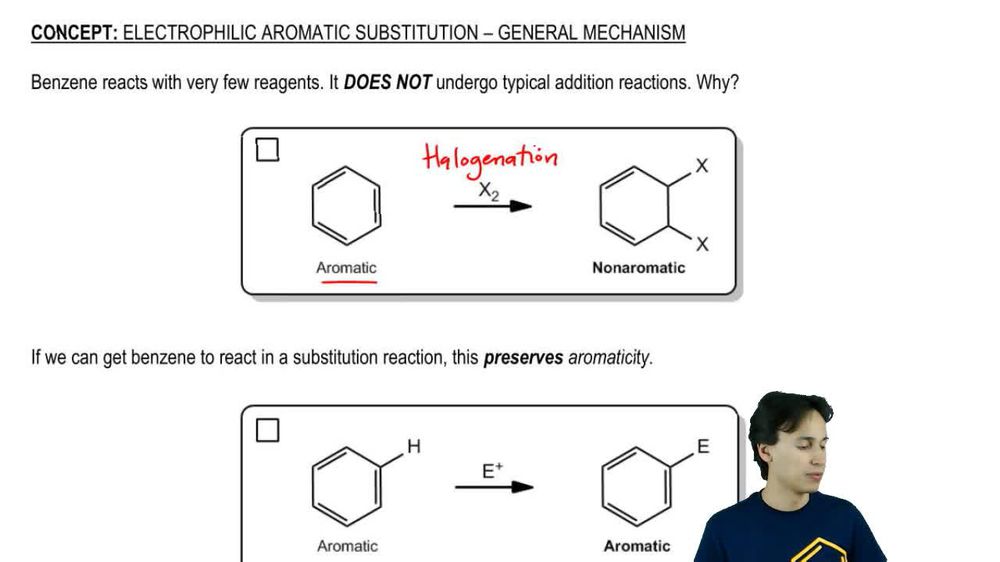
Electrophilic Aromatic Substitution is a fundamental reaction in organic chemistry where an electrophile replaces a hydrogen atom on an aromatic ring. In this process, the aromaticity of the ring is preserved, and the reaction typically involves the formation of a sigma complex. Understanding EAS is crucial for predicting the products of reactions involving aromatic compounds, such as nitrobenzene with fuming sulfuric acid.
In EAS reactions, substituents on the aromatic ring can either activate or deactivate the ring towards further substitution. Activating groups, such as -OH or -NH2, increase the electron density of the ring, making it more reactive, while deactivating groups, like -NO2 or -SO3H, withdraw electron density and make the ring less reactive. Recognizing the nature of substituents is essential for predicting the major products of the reaction.
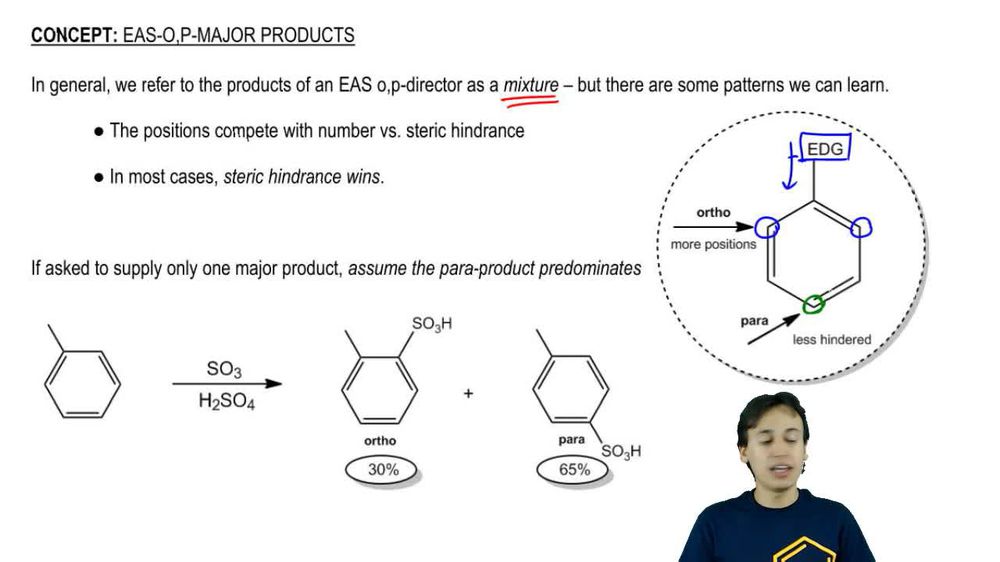
The position at which a new substituent is added to an aromatic ring during EAS is influenced by the existing substituents. Ortho and para directing groups favor substitution at the 2 or 4 positions relative to themselves, while meta directing groups favor substitution at the 3 position. This concept is vital for determining the specific products formed when nitrobenzene reacts with fuming sulfuric acid, as the existing nitro group will influence the site of new substitution.