Draw a Fischer projection for each compound. Remember that the cross represents an asymmetric carbon atom, and the carbon chain should be along the vertical, with the IUPAC numbering from top to bottom. (e)
Verified step by step guidance
1
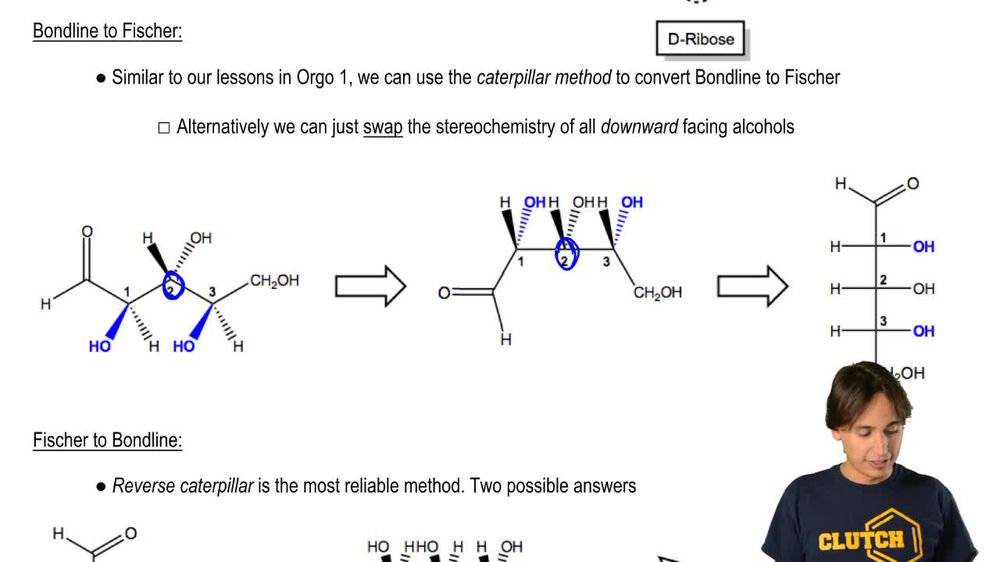
Step 1: Understand the Fischer projection. A Fischer projection is a two-dimensional representation of a molecule where the vertical line represents the carbon chain, and the horizontal lines represent substituents coming out of the plane of the paper. The cross represents an asymmetric carbon atom.
Step 2: Identify the asymmetric carbon atom in (R)-glyceraldehyde. In the provided structure, the second carbon (C2) is the asymmetric carbon because it is bonded to four different groups: a hydroxyl group (-OH), a hydrogen atom (-H), a methyl group (-CH2OH), and an aldehyde group (-CHO).
Step 3: Arrange the carbon chain vertically. In the Fischer projection, the aldehyde group (-CHO) is placed at the top (C1), the hydroxymethyl group (-CH2OH) is placed at the bottom (C3), and the asymmetric carbon (C2) is in the middle.
Step 4: Assign the substituents on the asymmetric carbon (C2). For (R)-glyceraldehyde, the hydroxyl group (-OH) is placed on the right side, and the hydrogen atom (-H) is placed on the left side in the Fischer projection. This arrangement corresponds to the (R)-configuration.
Step 5: Draw the Fischer projection. The vertical line represents the carbon chain with C1 at the top and C3 at the bottom. The horizontal line at C2 shows the substituents: -OH on the right and -H on the left. Ensure the numbering follows the IUPAC convention from top to bottom.
Verified video answer for a similar problem:
This video solution was recommended by our tutors as helpful for the problem above
Video duration:
3m
Play a video:
0 Comments
Key Concepts
Here are the essential concepts you must grasp in order to answer the question correctly.
Fischer Projections
Fischer projections are a two-dimensional representation of three-dimensional organic molecules, particularly useful for depicting stereochemistry. In these diagrams, vertical lines represent bonds that project behind the plane of the page, while horizontal lines represent bonds that project out towards the viewer. This format is especially important for visualizing the configuration of chiral centers in carbohydrates and amino acids.
Chirality refers to the property of a molecule that makes it non-superimposable on its mirror image, often due to the presence of one or more asymmetric carbon atoms. An asymmetric carbon, or chiral center, is a carbon atom bonded to four different groups, leading to two possible configurations (R or S). Understanding chirality is crucial for determining the optical activity and biological function of organic compounds.
IUPAC nomenclature is a systematic method for naming organic chemical compounds, ensuring that each compound has a unique and descriptive name. The rules dictate how to identify the longest carbon chain, number the carbon atoms, and name substituents. In the context of Fischer projections, proper IUPAC naming helps in accurately representing the structure and configuration of the molecule, such as (R)-glyceraldehyde.

 3:59 minutes
 Verified step by step guidance
 09:56
09:56