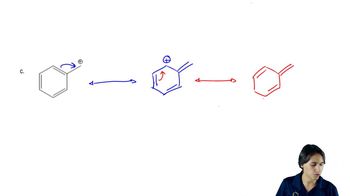
Look closely at the resonance structures of the benzylic anions, radicals, and cations in Figures 24.2–24.4. On which benzene carbons did the charge/radical exist in the resonance structures—that is, were they ortho, meta, or para?
Verified step by step guidance
1
Begin by understanding the concept of resonance structures. Resonance structures are different Lewis structures for the same molecule that show the delocalization of electrons. They are used to represent molecules where the electron distribution cannot be described by a single Lewis structure.
Identify the benzylic position in the benzene ring. The benzylic position refers to the carbon atom directly attached to the benzene ring, which can bear a charge or radical.
Examine the resonance structures of benzylic anions, radicals, and cations. In these structures, the charge or radical can be delocalized across the benzene ring, affecting different carbon atoms.
Determine the positions of the benzene carbons where the charge or radical is delocalized. These positions can be ortho (adjacent to the benzylic position), meta (one carbon away from the benzylic position), or para (opposite to the benzylic position).
Analyze the resonance structures to see which positions (ortho, meta, or para) are involved in the delocalization of the charge or radical. This will help you understand the stability and reactivity of the benzylic intermediates.
Verified video answer for a similar problem:
This video solution was recommended by our tutors as helpful for the problem above
Play a video:
0 Comments
Key Concepts
Here are the essential concepts you must grasp in order to answer the question correctly.
Resonance Structures
Resonance structures are different ways of drawing the same molecule that illustrate the delocalization of electrons. In organic chemistry, they help visualize how electrons can be distributed across a molecule, particularly in systems with conjugated double bonds or lone pairs. The actual structure of the molecule is a hybrid of these resonance forms, which contributes to its stability and reactivity.
The benzylic position refers to the carbon atom directly attached to a benzene ring. This position is significant because it can stabilize charges or radicals through resonance with the aromatic system. Understanding the reactivity and stability of benzylic anions, radicals, and cations is crucial for predicting the behavior of these species in chemical reactions.
Ortho, meta, and para refer to the relative positions of substituents on a benzene ring. Ortho indicates adjacent carbons, meta indicates carbons separated by one carbon, and para indicates carbons opposite each other on the ring. The stability and reactivity of intermediates like anions, radicals, and cations can vary significantly depending on their position relative to other substituents, influencing the overall reaction pathway.