Predict the product(s) you would expect from treatment of each compound with (1) dilute, neutral KMnO4 and (2) warm basic KMnO4, then dilute acid. (a) hex-1-yne
Verified step by step guidance
1
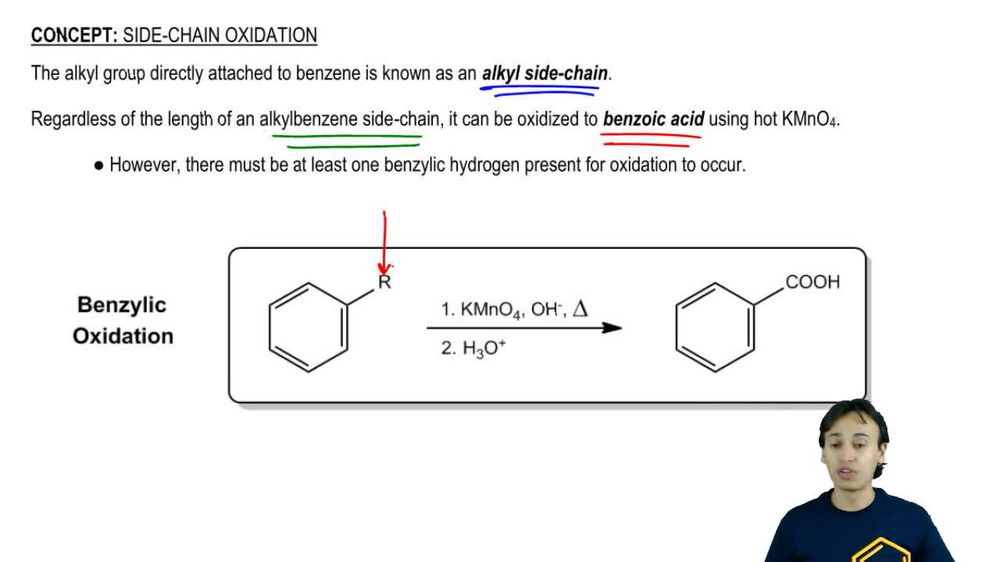
Step 1: Understand the reactivity of KMnO4 with alkynes. Neutral, dilute KMnO4 typically performs mild oxidation, while warm, basic KMnO4 followed by acid treatment leads to oxidative cleavage of the triple bond.
Step 2: For reaction with dilute, neutral KMnO4, recognize that hex-1-yne will undergo mild oxidation. The triple bond will be converted into a diol (a compound with two hydroxyl groups) at the site of the triple bond.
Step 3: For reaction with warm, basic KMnO4 followed by acid treatment, understand that the triple bond in hex-1-yne will be cleaved completely. Each carbon of the triple bond will be oxidized to form carboxylic acids.
Step 4: Identify the structure of hex-1-yne. It is a six-carbon alkyne with the triple bond located between the first and second carbons. For oxidative cleavage, the products will depend on the position of the triple bond.
Step 5: Predict the products. For dilute KMnO4, the product will be a diol at the triple bond site. For warm, basic KMnO4 followed by acid, the triple bond will cleave, yielding acetic acid (CH₃COOH) and pentanoic acid (C₄H₉COOH).
Verified video answer for a similar problem:
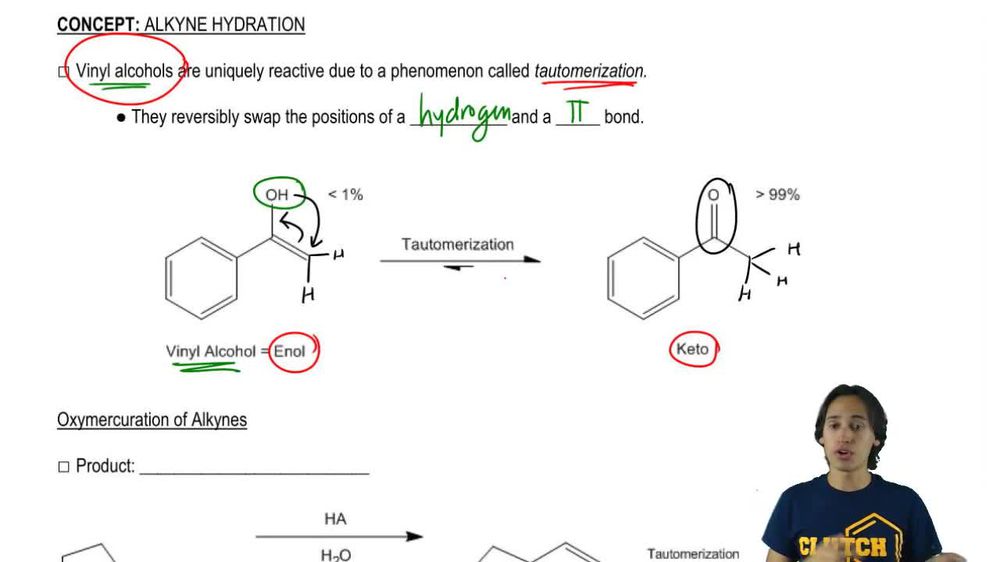
This video solution was recommended by our tutors as helpful for the problem above
Video duration:
5m
Play a video:
0 Comments
Key Concepts
Here are the essential concepts you must grasp in order to answer the question correctly.
Alkyne Reactivity
Alkynes, characterized by a carbon-carbon triple bond, undergo various reactions due to their high reactivity. They can participate in addition reactions, where reagents add across the triple bond, and oxidation reactions, which can lead to the formation of carbonyl compounds or carboxylic acids depending on the conditions.
Potassium permanganate (KMnO4) is a strong oxidizing agent used in organic chemistry. In dilute, neutral conditions, it typically oxidizes alkynes to form cis-diol products, while in warm basic conditions followed by acid treatment, it can cleave the triple bond, resulting in carboxylic acids or ketones, depending on the structure of the alkyne.
The mechanism of oxidation with KMnO4 involves the formation of a cyclic manganate ester intermediate, which subsequently leads to the addition of hydroxyl groups across the double bond. Understanding this mechanism is crucial for predicting the products of the reaction, as it dictates the stereochemistry and the nature of the final products formed from the alkyne.