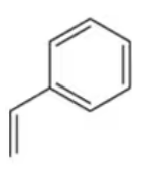
Predict the product(s) that would result when the following molecules are allowed to react under the following conditions: (ii) 1. Hg(OAc)2 2. NaBH4.If there is no reaction, write 'no reaction.' (a)
Verified step by step guidance
1
Step 1: Recognize the reaction type. The reagents provided, Hg(OAc)₂ followed by NaBH₄, indicate an oxymercuration-demercuration reaction. This reaction is used to hydrate alkenes (add water across a double bond) without carbocation rearrangement.
Step 2: Identify the functional group in the starting molecule. Check if the molecule contains an alkene (C=C double bond), as this reaction specifically targets alkenes.
Step 3: Understand the mechanism. In the first step, Hg(OAc)₂ reacts with the alkene to form a mercurinium ion intermediate. Water then attacks the more substituted carbon of the intermediate, leading to the addition of an -OH group. In the second step, NaBH₄ reduces the mercury group, replacing it with a hydrogen atom.
Step 4: Predict the product. The final product will be an alcohol, with the -OH group added to the more substituted carbon of the original double bond (Markovnikov addition). If the starting molecule does not contain an alkene, there will be no reaction.
Step 5: Verify the conditions. Ensure that the reaction conditions are suitable for the starting molecule. If the molecule lacks a double bond or has functional groups incompatible with the reaction, write 'no reaction.'
Verified video answer for a similar problem:
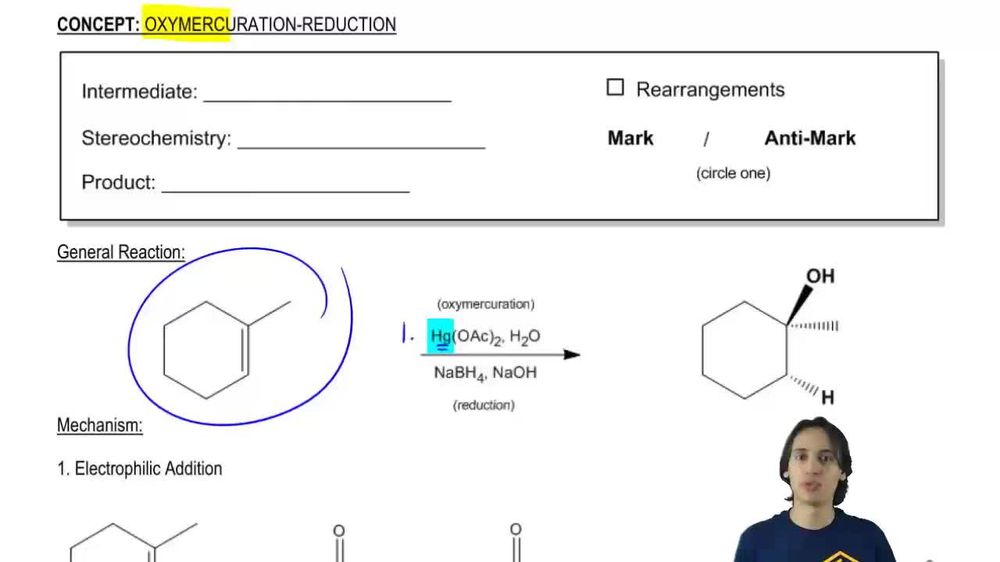
This video solution was recommended by our tutors as helpful for the problem above
Play a video:
0 Comments
Key Concepts
Here are the essential concepts you must grasp in order to answer the question correctly.
Mercuration-Demercuration
The mercuration-demercuration reaction is a two-step process used to convert alkenes into alcohols. In the first step, mercuric acetate (Hg(OAc)₂) adds to the double bond of the alkene, forming a mercurinium ion. The second step involves the reduction of this intermediate by sodium borohydride (NaBH₄), which replaces the mercury with a hydrogen atom, yielding an alcohol.
Regioselectivity refers to the preference of a chemical reaction to yield one structural isomer over others when multiple possibilities exist. In the context of mercuration, the reaction typically follows Markovnikov's rule, where the more substituted carbon atom of the alkene becomes bonded to the mercury, leading to the formation of the more stable carbocation intermediate.
Reduction reactions involve the gain of electrons or the decrease in oxidation state by a molecule. In the context of the mercuration-demercuration process, sodium borohydride acts as a reducing agent, facilitating the conversion of the mercurinium ion to an alcohol by donating electrons and protons, effectively replacing the mercury with a hydrogen atom.