Draw a reaction-energy diagram for a two-step endothermic reaction with a rate-limiting second step.
Verified step by step guidance
1
Start by understanding the key features of the reaction-energy diagram: the y-axis represents the energy of the system, and the x-axis represents the reaction progress. Since the reaction is endothermic, the energy of the products will be higher than the energy of the reactants.
Identify that the reaction occurs in two steps. Each step will have its own energy barrier (activation energy) and transition state. The second step is rate-limiting, meaning it has the higher activation energy compared to the first step.
Draw the energy of the reactants as a horizontal line on the left side of the diagram. Then, sketch the energy profile for the first step, showing a small peak (transition state) followed by an intermediate that is lower in energy than the peak but higher than the reactants.
For the second step, draw a larger peak (higher activation energy) starting from the intermediate. This peak represents the transition state of the rate-limiting step. The energy of the products should be higher than the energy of the reactants, reflecting the endothermic nature of the reaction.
Label all key points on the diagram: the reactants, the intermediate, the products, the two transition states, and the activation energies for each step. Clearly indicate that the second step has the higher activation energy, making it the rate-limiting step.
Verified video answer for a similar problem:
This video solution was recommended by our tutors as helpful for the problem above
Video duration:
3m
Play a video:
0 Comments
Key Concepts
Here are the essential concepts you must grasp in order to answer the question correctly.
Reaction Energy Diagram
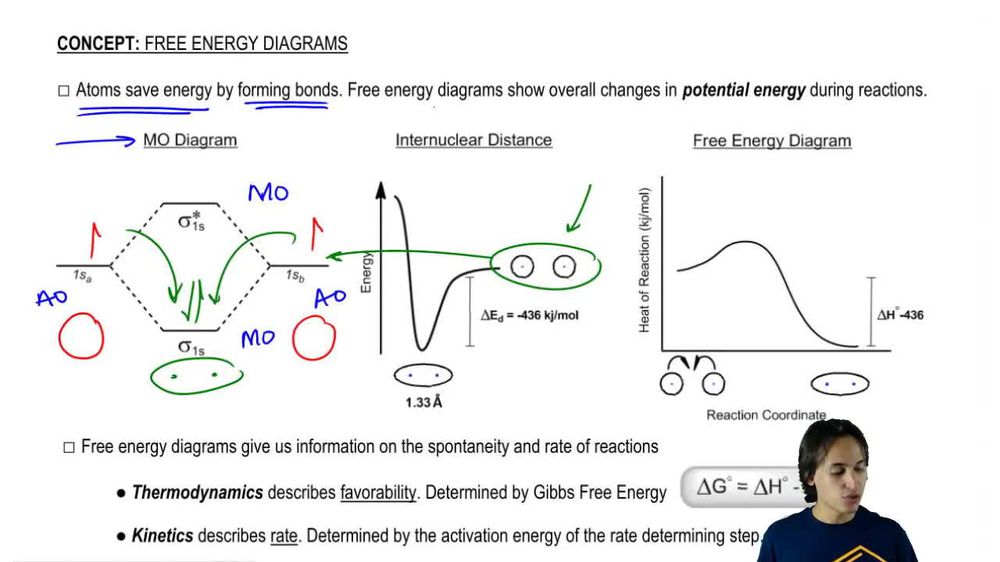
A reaction energy diagram visually represents the energy changes during a chemical reaction. It typically plots the energy of the reactants, products, and transition states against the reaction coordinate. The diagram helps illustrate the energy barriers that must be overcome for the reaction to proceed, highlighting the differences in energy between the reactants and products.
An endothermic reaction is a type of chemical reaction that absorbs energy from its surroundings, usually in the form of heat. This results in a net increase in the energy of the products compared to the reactants. In a reaction-energy diagram, endothermic reactions are characterized by a higher energy level of the products relative to the reactants, indicating that energy input is required for the reaction to occur.
The rate-limiting step in a multi-step reaction is the slowest step that determines the overall rate of the reaction. It acts as a bottleneck, meaning that even if other steps are faster, the rate of the entire reaction cannot exceed that of the rate-limiting step. In a two-step endothermic reaction, the second step being rate-limiting implies that it has the highest activation energy, which is reflected in the energy diagram as a significant peak.