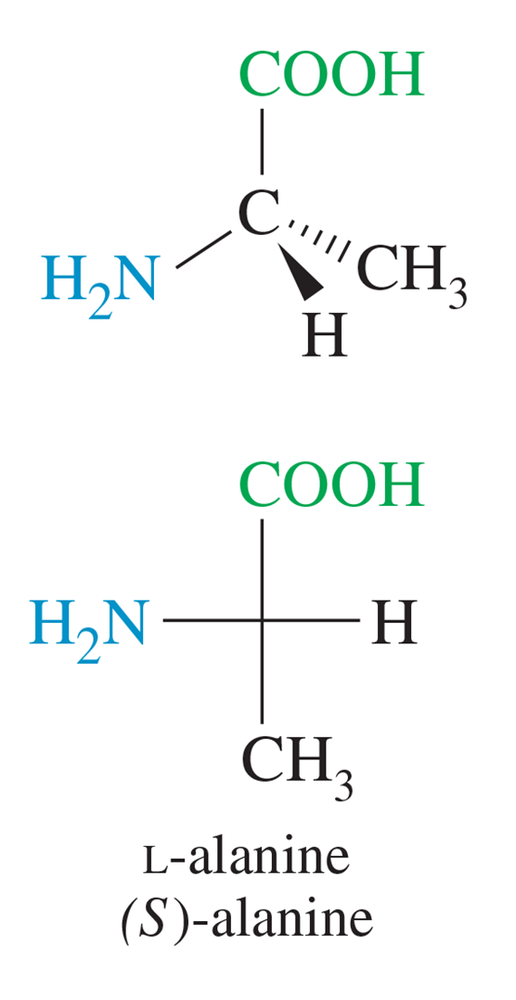
Most naturally occurring amino acids have chiral centers (the asymmetric α carbon atoms) that are named (S) by the Cahn–Ingold–Prelog convention (Section 5-3). The common naturally occurring form of cysteine has a chiral center that is named (R), however. (b) (S)-Alanine is an L-amino acid (Figure 24-2). Is (R)-cysteine a d-amino acid or an L-amino acid?
Verified step by step guidance
1
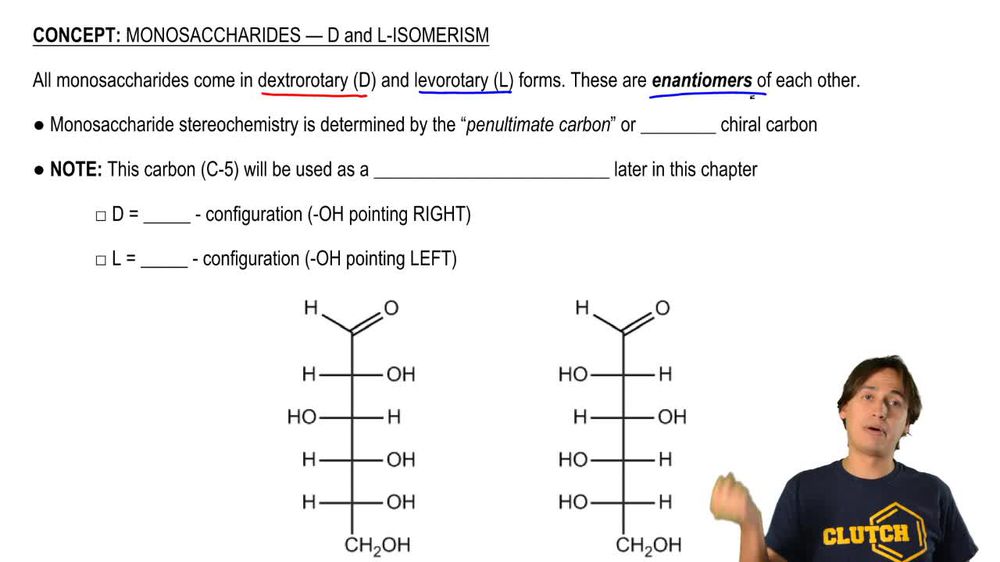
Understand the relationship between the (R)/(S) configuration and the d-/l- notation. The (R)/(S) system is based on the Cahn–Ingold–Prelog priority rules, while the d-/l- notation is based on the molecule's relationship to glyceraldehyde and its optical activity.
Recall that l-amino acids are the naturally occurring form of amino acids in proteins. They are defined by their structural similarity to l-glyceraldehyde, not by their (R)/(S) configuration.
Analyze the structure of (R)-cysteine. Even though it has an (R) configuration, its spatial arrangement corresponds to that of l-amino acids when compared to l-glyceraldehyde.
Conclude that (R)-cysteine is still classified as an l-amino acid because the d-/l- notation is independent of the (R)/(S) configuration and is instead based on the molecule's overall stereochemical relationship to l-glyceraldehyde.
Note that this is an exception to the general trend where most naturally occurring l-amino acids have the (S) configuration, with cysteine being a notable exception due to the sulfur atom in its side chain affecting priority rules.
Verified video answer for a similar problem:
This video solution was recommended by our tutors as helpful for the problem above
Video duration:
4m
Play a video:
0 Comments
Key Concepts
Here are the essential concepts you must grasp in order to answer the question correctly.
Chirality and Stereochemistry
Chirality refers to the property of a molecule that makes it non-superimposable on its mirror image, often due to the presence of chiral centers, typically carbon atoms bonded to four different substituents. In organic chemistry, stereochemistry is crucial for understanding how the spatial arrangement of atoms affects the properties and reactivity of molecules, particularly in biological systems.
The Cahn–Ingold–Prelog (CIP) convention is a set of rules used to assign priority to the substituents attached to a chiral center, allowing chemists to determine the absolute configuration of the chiral center as either (R) or (S). This systematic approach is essential for accurately describing the stereochemistry of amino acids and other chiral compounds.
Amino acids are classified as L- or D- based on the configuration of the chiral center farthest from the carboxyl group. L-amino acids, which are the predominant form in proteins, have the amino group on the left in a Fischer projection, while D-amino acids have it on the right. This classification is important for understanding the biological roles and functions of amino acids in living organisms.