Choose the member of each pair that will react faster by the SN1 mechanism. c. n-propyl bromide or allyl bromide d. 1-bromo-2,2-dimethylpropane or 2-bromopropane
Verified step by step guidance
1
Step 1: Recall the key factors that influence the SN1 reaction rate. The SN1 mechanism involves the formation of a carbocation intermediate, so the stability of the carbocation is the most critical factor. More stable carbocations form faster, leading to a faster reaction.
Step 2: Analyze the first pair: n-propyl bromide and allyl bromide. When n-propyl bromide undergoes ionization, it forms a primary carbocation, which is relatively unstable. In contrast, allyl bromide forms an allylic carbocation, which is stabilized by resonance. Resonance stabilization makes the allylic carbocation much more stable than the primary carbocation.
Step 3: Conclude for the first pair: Since the allylic carbocation is more stable due to resonance, allyl bromide will react faster via the SN1 mechanism compared to n-propyl bromide.
Step 4: Analyze the second pair: 1-bromo-2,2-dimethylpropane and 2-bromopropane. When 1-bromo-2,2-dimethylpropane ionizes, it forms a tertiary carbocation, which is highly stable due to inductive effects and hyperconjugation from the surrounding alkyl groups. On the other hand, 2-bromopropane forms a secondary carbocation, which is less stable than a tertiary carbocation.
Step 5: Conclude for the second pair: Since the tertiary carbocation formed by 1-bromo-2,2-dimethylpropane is more stable, it will react faster via the SN1 mechanism compared to 2-bromopropane.
Verified video answer for a similar problem:
This video solution was recommended by our tutors as helpful for the problem above
Video duration:
5m
Play a video:
0 Comments
Key Concepts
Here are the essential concepts you must grasp in order to answer the question correctly.
SN1 Mechanism
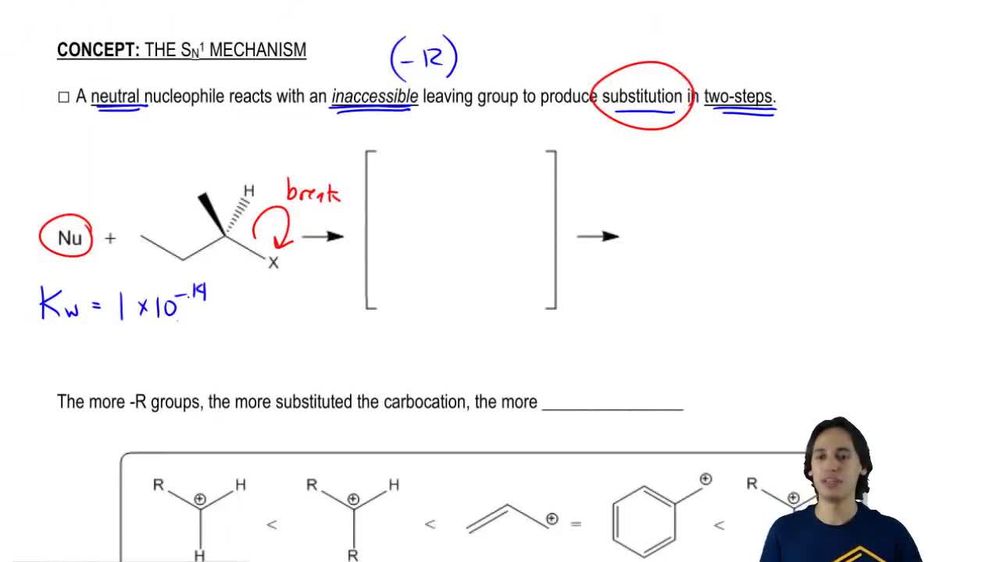
The SN1 mechanism is a type of nucleophilic substitution reaction that proceeds in two steps: the formation of a carbocation intermediate followed by nucleophilic attack. The rate of the reaction depends primarily on the stability of the carbocation formed. More stable carbocations, such as tertiary or allylic ones, will lead to faster reactions.
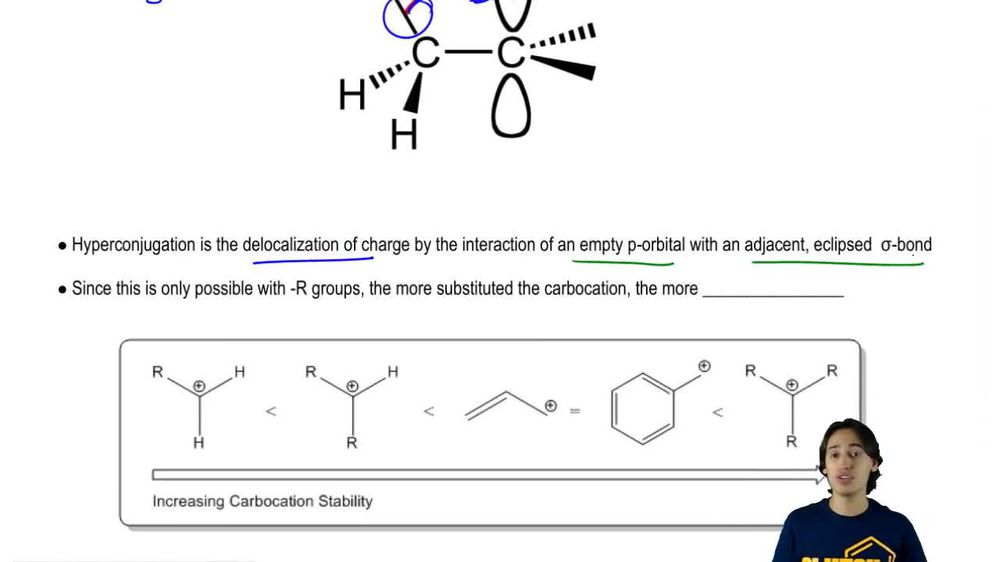
Carbocation stability is crucial in determining the rate of SN1 reactions. Carbocations are stabilized by hyperconjugation and inductive effects from adjacent alkyl groups. Tertiary carbocations are the most stable, followed by secondary and primary. Allylic carbocations, which can delocalize charge through resonance, are also relatively stable.
The nature of substituents on the carbon atom bearing the leaving group influences the reaction rate. Electron-donating groups can stabilize the carbocation, while steric hindrance can impede the formation of the carbocation. In the context of the given pairs, the structure of the alkyl groups attached to the leaving group (bromide) will determine which compound reacts faster via the SN1 mechanism.