Propose a synthetic sequence of this trisubstituted benzene starting from toluene.
Verified step by step guidance
1
Step 1: Begin with toluene as the starting material. Toluene is a methyl-substituted benzene, which can undergo electrophilic substitution reactions due to the activating effect of the methyl group.
Step 2: Perform nitration of toluene using a mixture of concentrated HNO₃ and H₂SO₄. This introduces a nitro group (-NO₂) at the ortho and para positions relative to the methyl group. The para product is typically favored due to steric hindrance.
Step 3: Brominate the nitrotoluene product using Br₂ in the presence of FeBr₃ as a catalyst. Bromination occurs at the remaining ortho position relative to the methyl group, as the nitro group is meta-directing and the methyl group is ortho/para-directing.
Step 4: Oxidize the methyl group to a carboxylic acid (-COOH) using a strong oxidizing agent such as KMnO₄ or Na₂Cr₂O₇ under acidic conditions. This converts the methyl group into a benzoic acid functional group.
Step 5: If necessary, adjust the halogen substituent (e.g., convert Br to Cl) using a halogen exchange reaction such as Finkelstein reaction or Sandmeyer reaction, depending on the desired halogen substituent in the final product.
Verified video answer for a similar problem:
This video solution was recommended by our tutors as helpful for the problem above
Video duration:
5m
Play a video:
0 Comments
Key Concepts
Here are the essential concepts you must grasp in order to answer the question correctly.
Electrophilic Aromatic Substitution (EAS)
Electrophilic Aromatic Substitution is a fundamental reaction in organic chemistry where an electrophile replaces a hydrogen atom on an aromatic ring. This reaction is crucial for synthesizing substituted aromatic compounds, as it allows for the introduction of various functional groups onto the benzene ring. Understanding the mechanism of EAS, including the role of activating and deactivating groups, is essential for proposing synthetic routes.
Substituents on an aromatic ring influence the position where new substituents can be added through EAS. Activating groups, such as -OH or -NH2, direct incoming electrophiles to the ortho and para positions, while deactivating groups, like -NO2 or -Cl, typically direct to the meta position. Recognizing these directing effects is vital for planning the synthetic sequence to achieve the desired trisubstituted benzene compound.
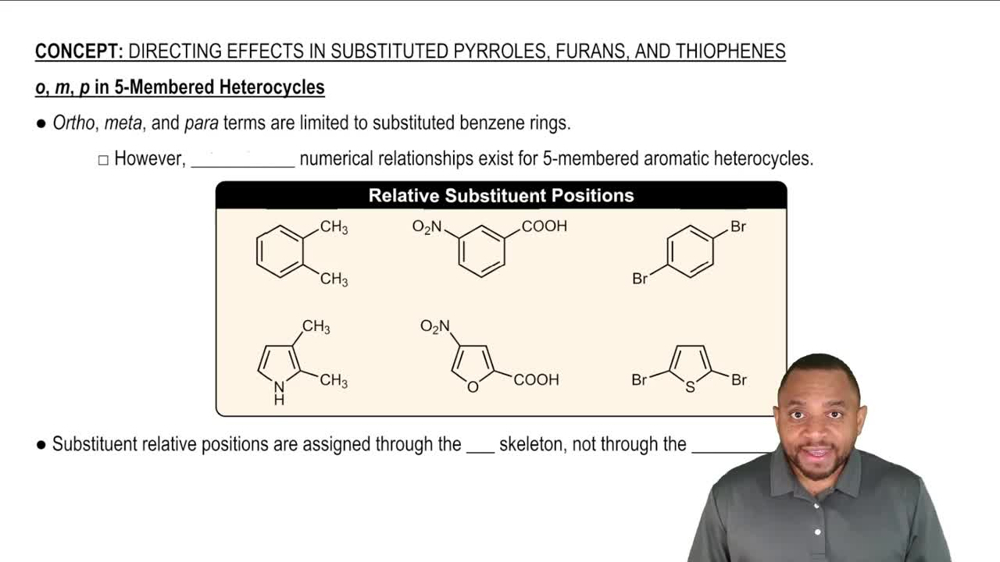
Directing Effects in Substituted Pyrroles, Furans, and Thiophenes Concept 1
Functional Group Transformations
Functional group transformations involve converting one functional group into another through various chemical reactions. In the context of synthesizing the target compound from toluene, transformations such as oxidation, halogenation, and nitration may be employed. Mastery of these transformations is necessary to navigate the synthetic pathway effectively and achieve the desired final product.

 5:02 minutes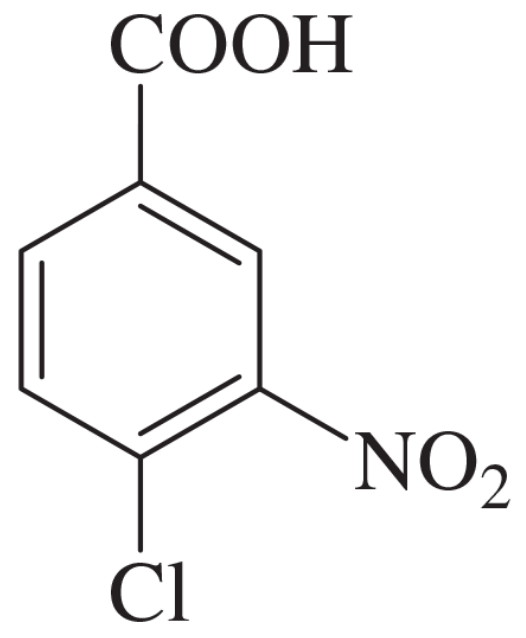
 Verified step by step guidance
 03:07
03:07