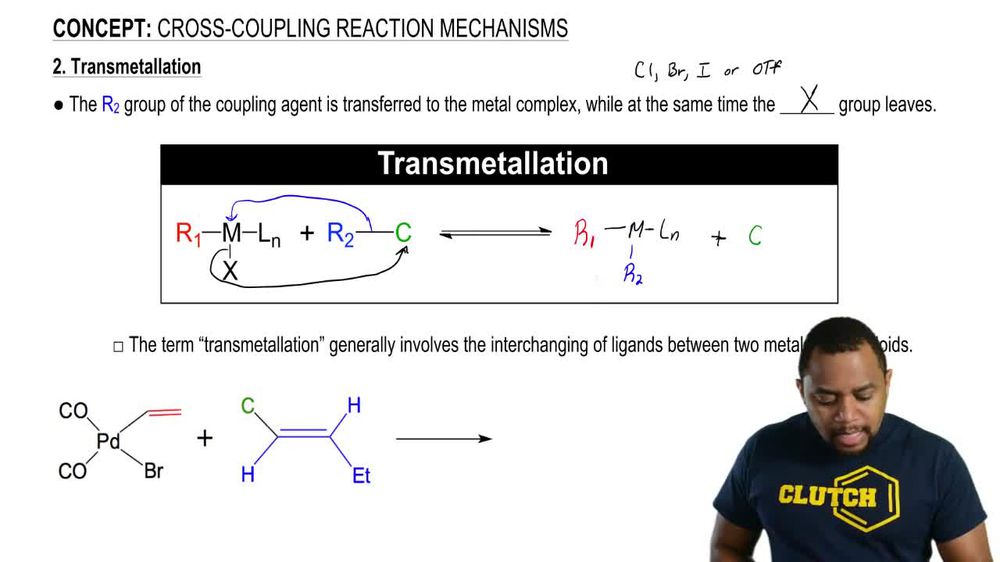
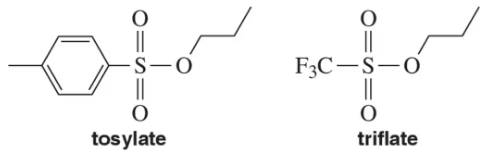
A trifluoromethanesulfonate (triflate) can be used in a manner similar to tosylates. Which would you expect to be a better leaving group? Why?
Verified step by step guidance
1
Step 1: Understand the concept of leaving groups. A good leaving group is one that can stabilize the negative charge after it departs from the molecule. This stability is often influenced by resonance, electronegativity, and inductive effects.
Step 2: Analyze the structure of tosylate. The tosylate group contains a benzene ring attached to a sulfonate group. The benzene ring provides resonance stabilization for the negative charge on the oxygen atoms of the sulfonate group, making it a relatively good leaving group.
Step 3: Analyze the structure of triflate. The triflate group contains a trifluoromethyl group attached to a sulfonate group. The trifluoromethyl group is highly electronegative due to the presence of three fluorine atoms, which exert a strong inductive effect. This inductive effect pulls electron density away from the sulfonate group, further stabilizing the negative charge on the oxygen atoms.
Step 4: Compare the stabilization mechanisms. While both tosylate and triflate stabilize the negative charge, triflate benefits from both inductive effects (from the electronegative fluorine atoms) and resonance stabilization within the sulfonate group. The trifluoromethyl group enhances the stability of the leaving group more effectively than the benzene ring in tosylate.
Step 5: Conclude that triflate is expected to be a better leaving group than tosylate due to the stronger inductive effect provided by the trifluoromethyl group, which leads to greater stabilization of the negative charge after departure.
Verified video answer for a similar problem:
This video solution was recommended by our tutors as helpful for the problem above
Play a video:
0 Comments
Key Concepts
Here are the essential concepts you must grasp in order to answer the question correctly.
Leaving Groups
Leaving groups are atoms or groups of atoms that can depart from a molecule during a chemical reaction, taking with them the electrons that were involved in the bond. A good leaving group is typically stable after departure and can stabilize the negative charge, making it more favorable for the reaction to proceed. Common examples include halides and sulfonate groups.
Trifluoromethanesulfonate, or triflate, is a sulfonate ester derived from trifluoromethanesulfonic acid. It is known for being an excellent leaving group due to the strong electron-withdrawing effect of the three fluorine atoms, which stabilize the negative charge on the leaving group after it departs. This property makes triflates highly reactive in nucleophilic substitution reactions.
Tosylates are derivatives of tosyl acid and serve as good leaving groups in organic reactions. The tosyl group (–OTs) is stable and can effectively stabilize the negative charge upon leaving. While tosylates are good leaving groups, triflates are generally considered superior due to their enhanced stability and reactivity, primarily attributed to the electronegative fluorine atoms in triflates.

 Verified step by step guidance
 07:22
07:22