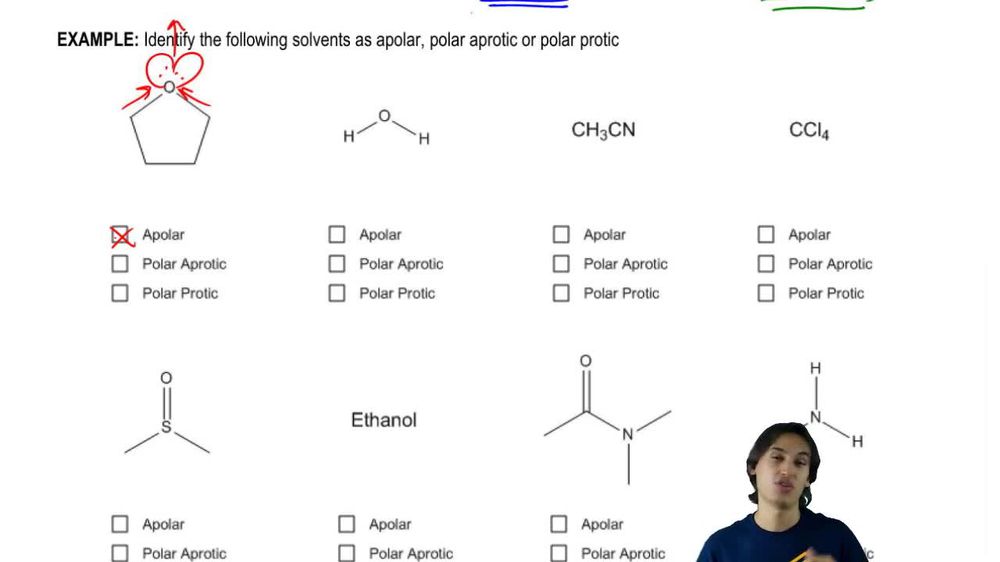
Which of the following solvents are reasonable choices for a Grignard reaction? Justify your choices. [Hint: Carbonyls are good electrophiles.]
Verified step by step guidance
1
Grignard reagents are highly reactive organomagnesium compounds that are sensitive to moisture and protic solvents. Therefore, the choice of solvent is crucial for the success of a Grignard reaction.
The first structure is tetrahydrofuran (THF), a cyclic ether. Ethers are generally good solvents for Grignard reactions because they can stabilize the Grignard reagent through coordination with the oxygen atom, and they do not contain acidic protons that would react with the Grignard reagent.
The second structure is ethyl acetate, an ester. Esters are not suitable solvents for Grignard reactions because they contain a carbonyl group, which is a good electrophile and would react with the Grignard reagent, leading to unwanted side reactions.
The third structure is ethanol, an alcohol. Alcohols are protic solvents and contain acidic protons that would react with the Grignard reagent, destroying it. Therefore, ethanol is not a suitable solvent for Grignard reactions.
The fourth structure is diethyl ether, a common solvent for Grignard reactions. Like THF, diethyl ether is an aprotic solvent that can stabilize the Grignard reagent without reacting with it. It is often used in Grignard reactions due to its ability to dissolve both the Grignard reagent and the organic substrate.
Verified video answer for a similar problem:
This video solution was recommended by our tutors as helpful for the problem above
Play a video:
0 Comments
Key Concepts
Here are the essential concepts you must grasp in order to answer the question correctly.
Grignard Reagents
Grignard reagents are organomagnesium compounds that are highly reactive and serve as nucleophiles in organic synthesis. They are formed by reacting alkyl or aryl halides with magnesium metal in anhydrous ether. Their reactivity allows them to attack electrophiles, such as carbonyl compounds, making them essential in forming new carbon-carbon bonds.
The choice of solvent in a Grignard reaction is critical because Grignard reagents are sensitive to moisture and can react with protic solvents, leading to their decomposition. Suitable solvents are typically non-polar and aprotic, such as diethyl ether or tetrahydrofuran (THF), which can stabilize the Grignard reagent without participating in the reaction.
Carbonyl compounds, such as aldehydes and ketones, are good electrophiles due to the polarized carbon-oxygen double bond, where the carbon atom carries a partial positive charge. This makes them susceptible to nucleophilic attack by Grignard reagents, facilitating the formation of alcohols after subsequent hydrolysis. Understanding this reactivity is crucial for predicting the outcomes of Grignard reactions.


 Verified step by step guidance
 02:12
02:12