
The product of the Stille coupling reaction (A) tautomerizes in a basic solution to give compound B. B spontaneously converts to C. (c) Suggest a mechanism for the conversion of B to C
Verified step by step guidance
1
Identify the structure of compound B and compound C. Understanding the functional groups and connectivity in these compounds is crucial for proposing a mechanism.
Consider the possible tautomerization or rearrangement processes that could occur in compound B. Look for functional groups that can undergo such transformations, such as enol-keto tautomerism or migration of double bonds.
Propose a mechanism for the conversion of B to C. This typically involves identifying a nucleophilic site in B that can attack an electrophilic site, leading to a rearrangement or formation of new bonds.
Draw the step-by-step mechanism, showing the movement of electrons using curved arrows. Ensure that each step is chemically feasible and follows the principles of organic chemistry, such as conservation of charge and atom connectivity.
Verify the proposed mechanism by checking if the final structure matches compound C. Ensure that all atoms and charges are accounted for and that the mechanism is consistent with known chemical behavior.
Verified video answer for a similar problem:
This video solution was recommended by our tutors as helpful for the problem above
Play a video:
0 Comments
Key Concepts
Here are the essential concepts you must grasp in order to answer the question correctly.
Stille Coupling Reaction
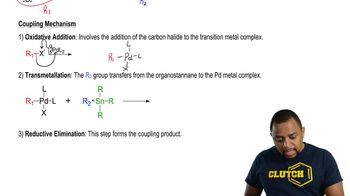
The Stille coupling reaction is a palladium-catalyzed cross-coupling process that forms carbon-carbon bonds between organotin compounds and organic halides. It is widely used in organic synthesis to construct complex molecules. Understanding the mechanism of this reaction is crucial for predicting the structure of the initial product (A) before it undergoes further transformations.
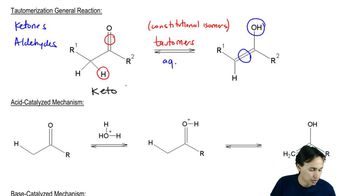
Tautomerization is a chemical reaction that results in the rearrangement of bonds within a molecule, typically involving the transfer of a hydrogen atom and a switch of a single bond and adjacent double bond. In a basic solution, this process can lead to the conversion of one isomer into another, such as keto-enol tautomerism, which is essential for understanding how compound A transforms into compound B.
The spontaneous conversion of compound B to C involves understanding the reaction mechanism, which includes identifying the intermediates and transition states. This process often involves rearrangements, eliminations, or additions that occur without external reagents. Analyzing the stability and reactivity of B can provide insights into the driving forces and steps leading to the formation of C.