Join thousands of students who trust us to help them ace their exams!
Multiple Choice
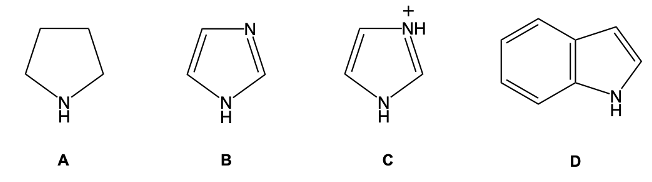
Rank following heterocycles in order of increasing basicity.
A
B < A < D < C
B
C < D < B < A
C
D < B < C < A
D
D < C < B < A
1 Comment
Verified step by step guidance
1
Identify the heterocycles: A is pyrrolidine, B is imidazole, C is imidazolium ion, and D is indole.
Understand basicity: Basicity in nitrogen-containing heterocycles is influenced by the availability of the lone pair of electrons on the nitrogen atom to accept a proton.
Analyze structure A (pyrrolidine): It is a saturated five-membered ring with a nitrogen atom. The nitrogen's lone pair is not involved in resonance, making it more available for protonation, thus more basic.
Analyze structure B (imidazole): It is an aromatic five-membered ring with two nitrogen atoms. One nitrogen's lone pair is involved in the aromatic sextet, while the other is available for protonation, making it less basic than pyrrolidine but more basic than imidazolium.
Analyze structure C (imidazolium ion): It is a protonated form of imidazole, carrying a positive charge. The positive charge reduces the availability of the nitrogen's lone pair for further protonation, making it less basic than imidazole.
Analyze structure D (indole): It is a bicyclic structure with a pyrrole ring fused to a benzene ring. The nitrogen's lone pair is involved in the aromatic sextet, making it less available for protonation, thus the least basic among the given heterocycles.
Rank the basicity: Based on the analysis, the order of increasing basicity is D < C < B < A.


 Verified step by step guidance

