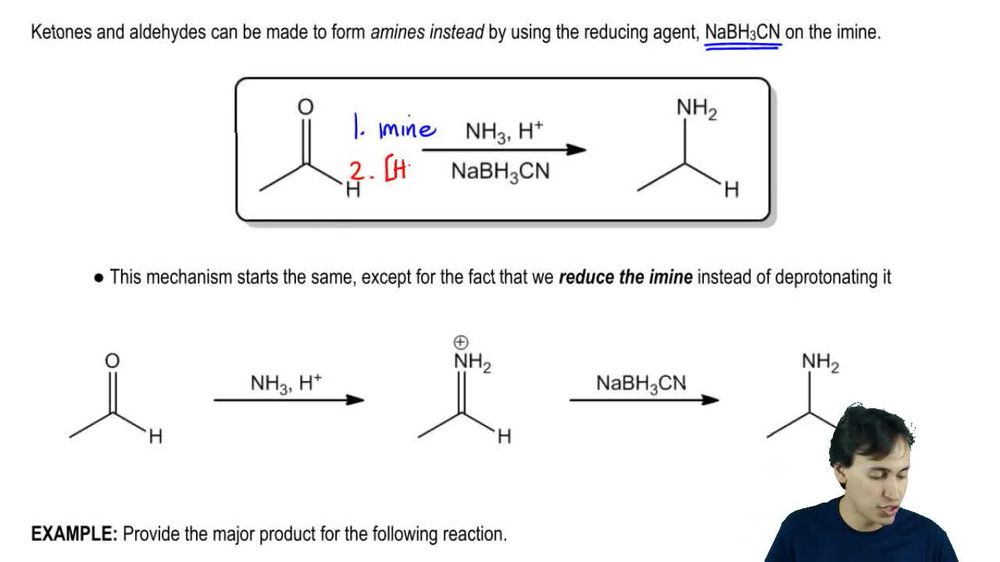
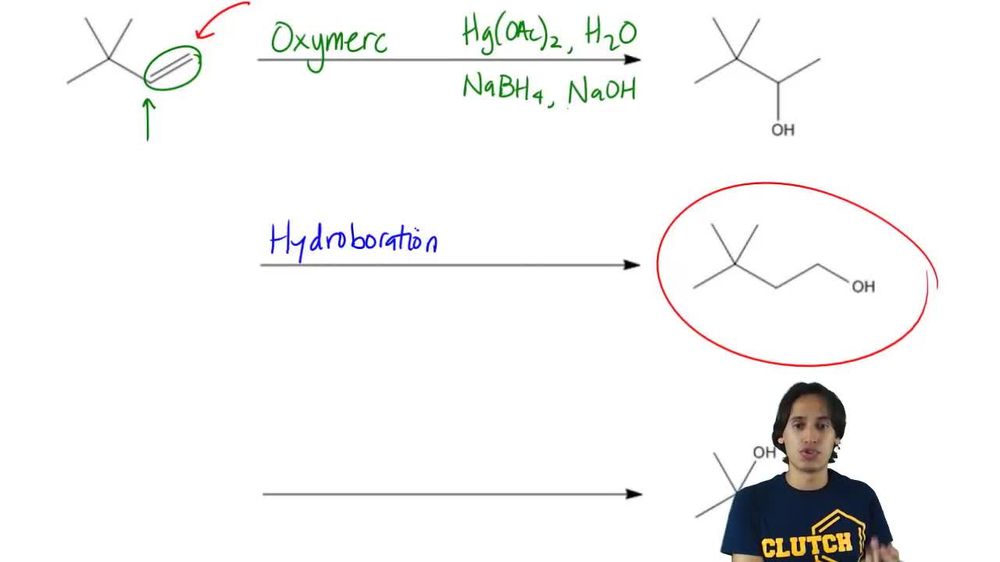
Suggest a reagent to carry out each of the following conversions to an alcohol. (d)
Verified step by step guidance
1
Step 1: Identify the starting material and the type of alcohol desired (primary, secondary, or tertiary). This will help determine the appropriate reagent and reaction pathway.
Step 2: If the starting material is an alkene, consider using hydroboration-oxidation (BH₃ followed by H₂O₂/NaOH) or oxymercuration-demercuration (Hg(OAc)₂ followed by NaBH₄) to convert the alkene into an alcohol.
Step 3: If the starting material is a carbonyl compound (aldehyde or ketone), use a reducing agent such as NaBH₄ or LiAlH₄ to reduce the carbonyl group to an alcohol. NaBH₄ is suitable for mild reductions, while LiAlH₄ is more reactive and can reduce esters and carboxylic acids as well.
Step 4: If the starting material is an alkyl halide, consider using aqueous NaOH or KOH for nucleophilic substitution to form an alcohol. Alternatively, you can use Ag₂O in water for a gentler conversion.
Step 5: If the starting material is an ester or carboxylic acid, use LiAlH₄ followed by acidic workup to reduce the compound to an alcohol. This reagent is strong enough to break the ester bond and reduce carboxylic acids.
Verified video answer for a similar problem:
This video solution was recommended by our tutors as helpful for the problem above
Video duration:
4m
Play a video:
0 Comments
Key Concepts
Here are the essential concepts you must grasp in order to answer the question correctly.
Alcohol Functional Group
Alcohols are organic compounds characterized by the presence of one or more hydroxyl (-OH) groups attached to a carbon atom. Understanding the structure and reactivity of alcohols is crucial for predicting how they can be synthesized or converted from other functional groups. The properties of alcohols, such as polarity and hydrogen bonding, influence their behavior in chemical reactions.
Reduction reactions involve the gain of electrons or the addition of hydrogen to a molecule, often resulting in the conversion of carbonyl compounds (like aldehydes or ketones) to alcohols. Common reducing agents include lithium aluminum hydride (LiAlH4) and sodium borohydride (NaBH4). Recognizing the type of carbonyl compound and the appropriate reducing agent is essential for successfully converting it to an alcohol.
Various reagents can be employed to synthesize alcohols from different starting materials. For example, Grignard reagents can react with carbonyl compounds to form alcohols, while hydrolysis of alkyl halides can also yield alcohols. Understanding the specific reagents and their mechanisms of action is vital for selecting the correct one for a given conversion.