What stereoisomers are obtained from the following reactions? c. (E)-3-methyl-2-pentene + HBr d. cis-3-hexene + HBr
Verified step by step guidance
1
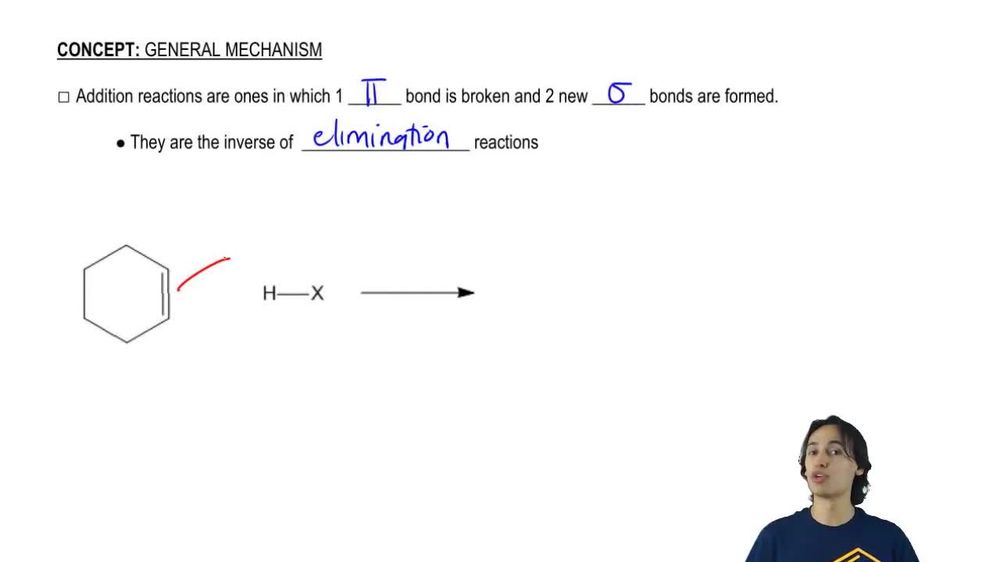
Step 1: Understand the reaction mechanism. Both reactions involve the addition of HBr to an alkene. This is an electrophilic addition reaction where the π bond of the alkene attacks the proton (H⁺) from HBr, forming a carbocation intermediate.
Step 2: Analyze the structure of the starting alkene. For part (c), (E)-3-methyl-2-pentene is an alkene with the substituents on opposite sides of the double bond. For part (d), cis-3-hexene has substituents on the same side of the double bond.
Step 3: Determine the regioselectivity of the reaction. According to Markovnikov's rule, the bromine (Br⁻) will add to the more substituted carbon of the double bond, as this stabilizes the carbocation intermediate.
Step 4: Consider stereochemistry. The addition of HBr can lead to the formation of stereoisomers due to the planar nature of the carbocation intermediate. The Br⁻ can attack from either side of the carbocation, resulting in a mixture of enantiomers or diastereomers depending on the starting alkene.
Step 5: Predict the stereoisomers formed. For (E)-3-methyl-2-pentene, the addition of HBr will yield two stereoisomers (enantiomers) due to the formation of a chiral center. For cis-3-hexene, the addition of HBr will also yield two stereoisomers (enantiomers) for the same reason. The exact stereoisomers depend on the spatial arrangement of the substituents after the addition.
Verified video answer for a similar problem:
This video solution was recommended by our tutors as helpful for the problem above
Video duration:
1m
Play a video:
0 Comments
Key Concepts
Here are the essential concepts you must grasp in order to answer the question correctly.
Stereoisomerism
Stereoisomerism refers to the phenomenon where compounds have the same molecular formula and connectivity of atoms but differ in the spatial arrangement of those atoms. This can lead to different physical and chemical properties. The two main types of stereoisomers are geometric isomers (cis/trans) and optical isomers (enantiomers). Understanding stereoisomerism is crucial for predicting the outcomes of reactions involving alkenes.
Electrophilic addition reactions are a fundamental type of reaction for alkenes, where an electrophile reacts with a nucleophile, typically the double bond of the alkene. In the case of alkenes reacting with HBr, the double bond opens up, allowing the bromine and hydrogen to add across the former double bond. The regioselectivity and stereochemistry of the addition depend on the structure of the alkene and the mechanism of the reaction.
Markovnikov's Rule states that in the addition of HX (where X is a halogen) to an alkene, the hydrogen atom will attach to the carbon with the greater number of hydrogen atoms already attached. This rule helps predict the major product of the reaction, especially in cases where the alkene is asymmetrical. Understanding this rule is essential for determining the stereoisomers formed during the reaction of alkenes with HBr.

 1:59 minutes
 Verified step by step guidance
 01:58
01:58