Using any alkene and any other reagents, how would you prepare the following compounds? e.
Verified step by step guidance
1
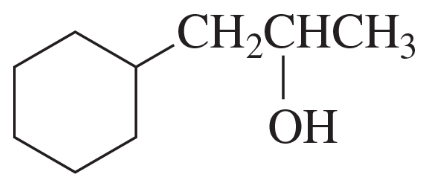
Step 1: Identify the target molecule. The compound shown is a cyclohexane ring with a 2-propanol group attached to it. This indicates that the desired product is an alcohol formed via the addition of a hydroxyl group (-OH) to an alkene.
Step 2: Choose an appropriate alkene precursor. To form the target molecule, the alkene should be cyclohexene (a cyclohexane ring with a double bond) and propene (CH3-CH=CH2). These two components will react to form the desired structure.
Step 3: Select the reaction mechanism. The hydroxyl group is attached to the secondary carbon of the propyl group, which suggests the use of hydroboration-oxidation. This reaction adds water across the double bond in an anti-Markovnikov fashion, ensuring the hydroxyl group attaches to the less substituted carbon.
Step 4: Perform the hydroboration step. React cyclohexene with propene in the presence of BH3 (borane) or a borane derivative such as B2H6. This step forms an organoborane intermediate where the boron atom attaches to the less substituted carbon of the alkene.
Step 5: Oxidize the organoborane intermediate. Treat the intermediate with hydrogen peroxide (H2O2) and a base such as NaOH. This step replaces the boron atom with a hydroxyl group (-OH), yielding the desired alcohol product.
Verified video answer for a similar problem:
This video solution was recommended by our tutors as helpful for the problem above
Video duration:
3m
Play a video:
0 Comments
Key Concepts
Here are the essential concepts you must grasp in order to answer the question correctly.
Alkene Reactivity
Alkenes are unsaturated hydrocarbons characterized by at least one carbon-carbon double bond. Their reactivity is primarily due to this double bond, which can undergo various reactions such as addition, oxidation, and polymerization. Understanding the types of reactions that alkenes can participate in is crucial for synthesizing target compounds.
Different reagents and reaction conditions can significantly influence the outcome of a reaction involving alkenes. Common reagents include acids, halogens, and oxidizing agents, each facilitating specific transformations. Knowing which reagents to use and the conditions required (like temperature and solvent) is essential for successfully preparing the desired compound.
Stereochemistry refers to the spatial arrangement of atoms in molecules and how this affects their chemical properties and reactions. In the context of alkene reactions, stereochemistry is particularly important when considering the formation of stereoisomers, which can arise from reactions like addition. Understanding stereochemical outcomes helps predict the structure of the final product.