What alkane, with molecular formula C5H12, forms only one monochlorinated product when it is heated with Cl2?
Verified step by step guidance
1
Identify the molecular formula of the alkane, C5H12, which corresponds to a saturated hydrocarbon with 5 carbon atoms and 12 hydrogen atoms.
Recall that for an alkane to form only one monochlorinated product, all the hydrogen atoms in the molecule must be equivalent. This means the alkane must have a symmetrical structure.
Consider the possible isomers of C5H12: pentane (straight-chain), isopentane (branched with one methyl group), and neopentane (branched with two methyl groups).
Analyze the symmetry of each isomer: Pentane and isopentane have multiple types of hydrogen atoms (primary, secondary, tertiary), leading to multiple monochlorinated products. Neopentane, however, has all 12 hydrogens equivalent due to its high symmetry.
Conclude that the alkane with molecular formula C5H12 that forms only one monochlorinated product is neopentane (2,2-dimethylpropane).
Verified video answer for a similar problem:
This video solution was recommended by our tutors as helpful for the problem above
Video duration:
3m
Play a video:
0 Comments
Key Concepts
Here are the essential concepts you must grasp in order to answer the question correctly.
Alkanes
Alkanes are saturated hydrocarbons consisting only of carbon and hydrogen atoms, connected by single bonds. They follow the general formula CnH2n+2, where 'n' is the number of carbon atoms. The structure of alkanes can vary from straight-chain to branched forms, influencing their chemical reactivity and properties.
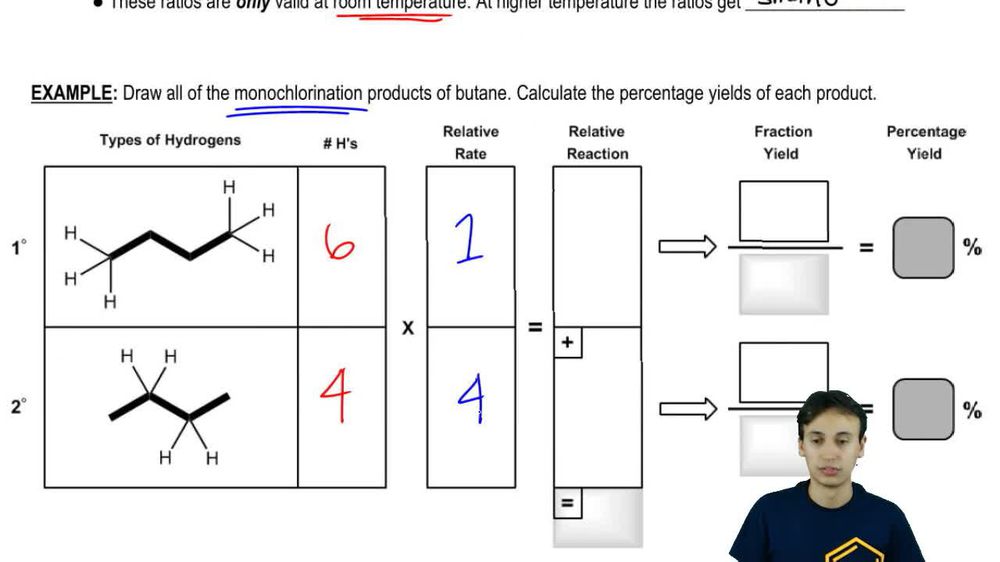
Monochlorination is a substitution reaction where one hydrogen atom in an alkane is replaced by a chlorine atom, typically using chlorine gas (Cl2) under heat or light. The process can lead to multiple products if the alkane has different hydrogen atoms that can be substituted, but some alkanes yield only one product due to their symmetrical structure.
Draw all of the monochlorination products and calculate percentage yields.
Symmetry in Organic Molecules
Symmetry in organic molecules refers to the arrangement of atoms that allows for identical environments for certain substituents. In the case of alkanes, a symmetrical structure means that all hydrogen atoms are equivalent, leading to only one possible product during reactions like chlorination. This concept is crucial for predicting the outcomes of substitution reactions.