Which substitution reaction takes place more rapidly? a. CH3CH2Br + H2O or CH3CH2Br + HO−
Verified step by step guidance
1
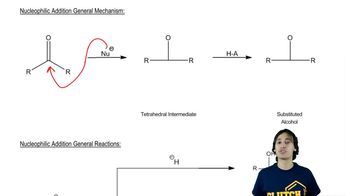
Step 1: Understand the type of substitution reaction involved. Both reactions involve nucleophilic substitution, where a nucleophile replaces a leaving group (Br−) in the molecule CH3CH2Br. The two reactions differ in the nucleophile: H2O (neutral) versus HO− (charged).
Step 2: Analyze the nucleophiles. H2O is a neutral molecule, while HO− is a negatively charged ion. Generally, negatively charged nucleophiles are stronger than neutral ones because they have a higher electron density, making them more reactive.
Step 3: Consider the reaction mechanism. CH3CH2Br is a primary alkyl halide, which typically undergoes SN2 (bimolecular nucleophilic substitution) reactions. In SN2 reactions, the rate depends on both the nucleophile and the substrate. A stronger nucleophile (HO−) will lead to a faster reaction compared to a weaker nucleophile (H2O).
Step 4: Evaluate the solvent effects. H2O is a polar protic solvent, which can stabilize the nucleophile through hydrogen bonding, reducing its reactivity. HO−, being a stronger nucleophile, is less affected by this stabilization and remains highly reactive.
Step 5: Conclude based on the above analysis. The reaction CH3CH2Br + HO− will take place more rapidly than CH3CH2Br + H2O due to the stronger nucleophilicity of HO− and the preference for SN2 mechanisms in primary alkyl halides.
Verified video answer for a similar problem:
This video solution was recommended by our tutors as helpful for the problem above
Video duration:
3m
Play a video:
0 Comments
Key Concepts
Here are the essential concepts you must grasp in order to answer the question correctly.
Nucleophilic Substitution Reactions
Nucleophilic substitution reactions involve the replacement of a leaving group in a molecule by a nucleophile. The rate of these reactions can depend on the strength and concentration of the nucleophile, as well as the nature of the leaving group. Understanding the mechanisms, such as SN1 and SN2, is crucial for predicting which reaction will occur more rapidly.
Nucleophiles and Electrophiles can react in Substitution Reactions.
Nucleophile Strength
Nucleophile strength refers to the ability of a species to donate an electron pair to form a bond with an electrophile. Stronger nucleophiles, like HO− (hydroxide ion), are more reactive than weaker ones, such as H2O (water). This concept is essential for determining the rate of substitution reactions, as stronger nucleophiles typically lead to faster reactions.
The choice of solvent can significantly influence the rate of nucleophilic substitution reactions. Polar protic solvents, like water, can stabilize ions and slow down reactions involving strong nucleophiles, while polar aprotic solvents can enhance nucleophile reactivity. Understanding how solvents interact with reactants helps predict the outcome and speed of the reaction.