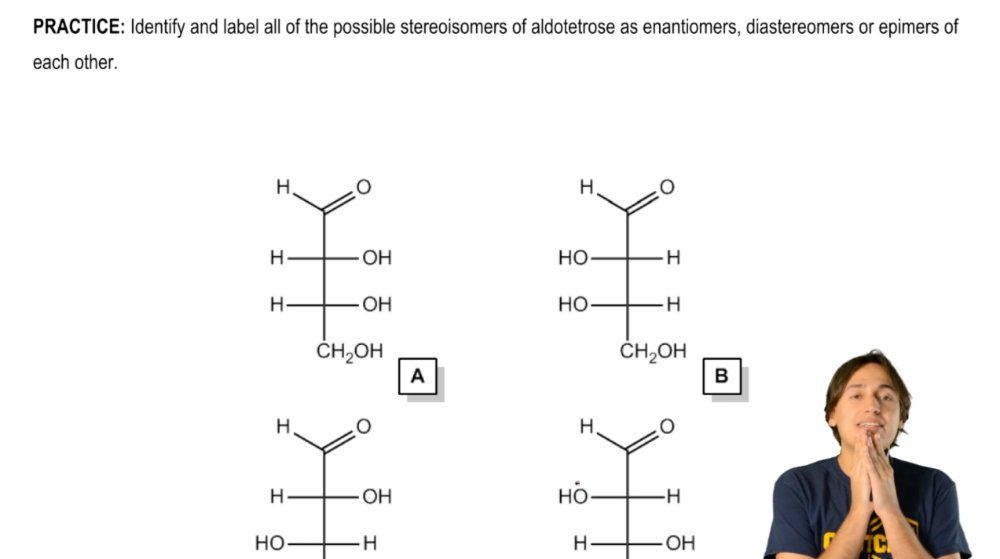
a. Stereoisomers with two asymmetric centers are called ___ if the configuration of both asymmetric centers in one stereoisomer is the opposite of the configuration of the symmetric centers in the other stereoisomer. b. Stereoisomers with two asymmetric centers are called ___ if the configuration of both asymmetric centers in one stereoisomer is the same as the configuration of the asymmetric centers in the other stereoisomer. c. Stereoisomers with two asymmetric centers are called ___ if one of the asymmetric centers has the same configuration in both stereoisomers and the other asymmetric center has the opposite configuration in the two stereoisomers.
Verified step by step guidance
1
Step 1: Understand the concept of stereoisomers. Stereoisomers are compounds that have the same molecular formula and connectivity of atoms but differ in the spatial arrangement of atoms. They include enantiomers and diastereomers.
Step 2: For part (a), recall that enantiomers are stereoisomers where the configurations of all asymmetric centers are opposite between the two molecules. This means that if one stereoisomer has an R configuration at both centers, the other will have an S configuration at both centers.
Step 3: For part (b), note that identical stereoisomers occur when the configuration of all asymmetric centers in one stereoisomer is the same as the configuration of the asymmetric centers in the other stereoisomer. This means there is no difference in spatial arrangement.
Step 4: For part (c), understand that diastereomers are stereoisomers where at least one asymmetric center has the same configuration in both molecules, while the other asymmetric center has opposite configurations. This partial difference in spatial arrangement distinguishes diastereomers from enantiomers.
Step 5: Summarize the definitions: (a) enantiomers have opposite configurations at all asymmetric centers, (b) identical stereoisomers have the same configurations at all asymmetric centers, and (c) diastereomers have opposite configurations at one asymmetric center and the same configuration at the other.
Verified video answer for a similar problem:
This video solution was recommended by our tutors as helpful for the problem above
Video duration:
4m
Play a video:
0 Comments
Key Concepts
Here are the essential concepts you must grasp in order to answer the question correctly.
Stereoisomers
Stereoisomers are compounds that have the same molecular formula and connectivity of atoms but differ in the spatial arrangement of their atoms. This category includes enantiomers and diastereomers, which are crucial for understanding the behavior of molecules in biological systems and their interactions. The presence of asymmetric centers, or chiral centers, in a molecule leads to the formation of these stereoisomers.
Chirality refers to the property of a molecule that makes it non-superimposable on its mirror image, often due to the presence of one or more asymmetric (chiral) centers. Each chiral center can exist in two configurations, typically designated as 'R' (rectus) or 'S' (sinister). The arrangement of these configurations determines the specific type of stereoisomerism exhibited by the molecule.
The two main types of stereoisomers are enantiomers and diastereomers. Enantiomers are stereoisomers that are mirror images of each other, while diastereomers are not. The question specifically addresses configurations of stereoisomers with two asymmetric centers, leading to classifications based on whether the centers are the same or opposite in configuration, which is essential for understanding their chemical properties and reactions.

 4:09 minutes
 Verified step by step guidance
 01:58
01:58