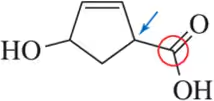
Given the line-angle drawings shown, answer the following questions: (i) How many carbons are in each molecule? (ii) How many hydrogens are at the circled carbon? (iii) Is the indicated (→) carbon or 1° , 2°, 3°, or 4°? (h)
Verified step by step guidance
1
Step 1: Analyze the line-angle drawing to determine the number of carbons in each molecule. In line-angle drawings, each vertex or endpoint represents a carbon atom unless otherwise specified. Count all the vertices and endpoints to find the total number of carbons.
Step 2: For the circled carbon, determine the number of hydrogens attached. Recall that carbon typically forms four bonds. Subtract the number of bonds already shown (to other atoms) from four to calculate the number of hydrogens attached to the circled carbon.
Step 3: Examine the indicated (→) carbon to determine its degree of substitution. A carbon is classified as: 1° (primary) if bonded to one other carbon, 2° (secondary) if bonded to two other carbons, 3° (tertiary) if bonded to three other carbons, and 4° (quaternary) if bonded to four other carbons.
Step 4: Verify your answers by carefully reviewing the line-angle drawing and ensuring that all bonds and implied hydrogens are accounted for. Double-check the degree of substitution for the indicated carbon.
Step 5: Summarize your findings for each part of the question: (i) the total number of carbons in each molecule, (ii) the number of hydrogens at the circled carbon, and (iii) the degree of substitution (1°, 2°, 3°, or 4°) for the indicated carbon.
Verified video answer for a similar problem:
This video solution was recommended by our tutors as helpful for the problem above
Video duration:
3m
Play a video:
0 Comments
Key Concepts
Here are the essential concepts you must grasp in order to answer the question correctly.
Line-Angle Structures
Line-angle drawings, also known as skeletal structures, are a shorthand representation of organic molecules. In these diagrams, vertices represent carbon atoms, and the ends of lines represent terminal carbon atoms. Hydrogen atoms are typically omitted for clarity, as they are implied based on carbon's tetravalency. Understanding how to interpret these drawings is essential for determining the number of carbon and hydrogen atoms in a molecule.
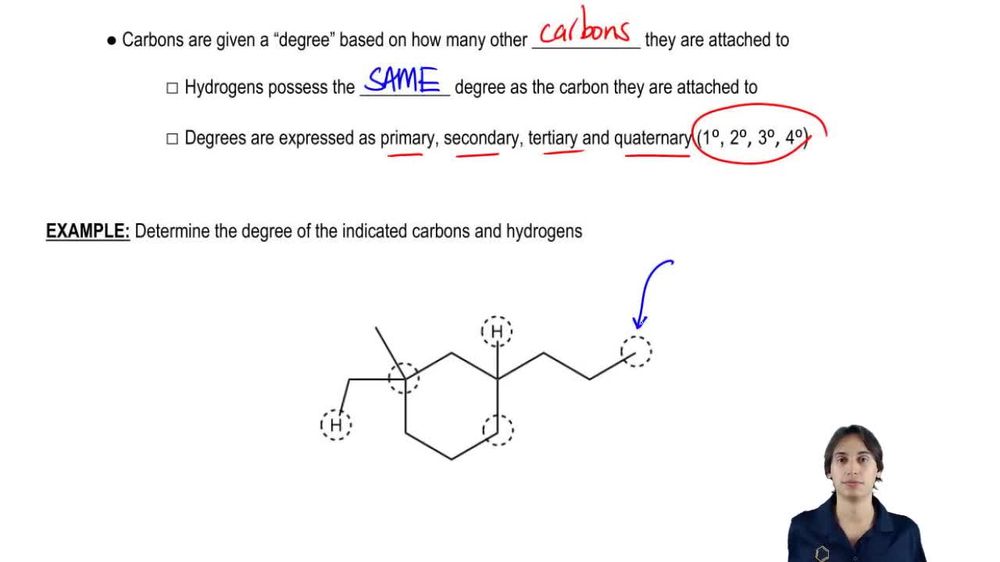
The degree of a carbon atom refers to the number of other carbon atoms directly bonded to it. A carbon can be classified as primary (1°) if it is attached to one other carbon, secondary (2°) if attached to two, tertiary (3°) if attached to three, and quaternary (4°) if attached to four. This classification is crucial for understanding the reactivity and stability of the molecule, as different degrees influence chemical behavior.
Determine the degree of the indicated carbons and hydrogens.
Hydrogen Count at Specific Carbons
The number of hydrogen atoms bonded to a carbon atom can be determined by considering the carbon's tetravalency, which states that carbon forms four bonds. The number of hydrogen atoms attached to a carbon depends on how many other atoms (including carbon) are bonded to it. For example, a primary carbon typically has three hydrogens, while a tertiary carbon has only one. This concept is vital for answering questions about specific carbons in a molecule.