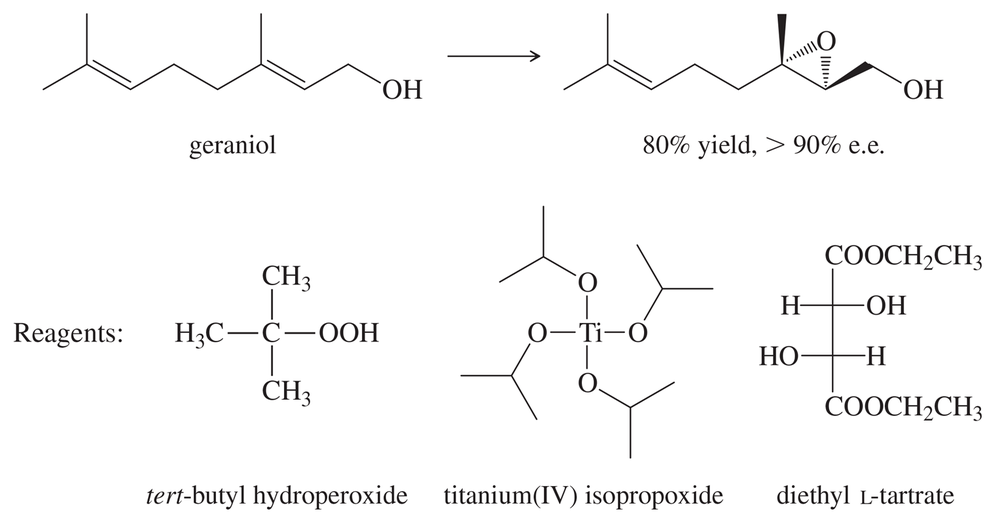
The 2001 Nobel Prize in Chemistry was awarded to three organic chemists who have developed methods for catalytic asymmetric syntheses. An asymmetric (or enantioselective) synthesis is one that converts an achiral starting material into mostly one enantiomer of a chiral product. K. Barry Sharpless (The Scripps Research Institute) developed an asymmetric epoxidation of allylic alcohols that gives excellent chemical yields and greater than 90% enantiomeric excess. The Sharpless epoxidation uses tert-butyl hydroperoxide, titanium(IV) isopropoxide, and a dialkyl tartrate ester as the reagents. The following epoxidation of geraniol is typical. (a) Which of these reagents is most likely to be the actual oxidizing agent? That is, which reagent is reduced in the reaction? What is the likely function of the other reagents? (b) When achiral reagents react to give a chiral product, that product is normally formed as a racemic mixture of enantiomers. How can the Sharpless epoxidation give just one nearly pure enantiomer of the product? (c) Draw the other enantiomer of the product. What reagents would you use if you wanted to epoxidize geraniol to give this other enantiomer?
Verified step by step guidance
1
Step 1: Identify the oxidizing agent in the Sharpless epoxidation. The tert-butyl hydroperoxide (CH₃C(CH₃)OOH) is most likely the oxidizing agent because it contains the peroxide functional group, which is reduced during the reaction.
Step 2: Determine the roles of the other reagents. Titanium(IV) isopropoxide acts as a Lewis acid catalyst, coordinating with the allylic alcohol to activate the double bond for epoxidation. Diethyl L-tartrate is a chiral ligand that induces asymmetry in the reaction, ensuring enantioselectivity.
Step 3: Explain how enantioselectivity is achieved. The chiral diethyl L-tartrate creates a chiral environment around the titanium center, which directs the formation of one enantiomer preferentially over the other. This prevents the formation of a racemic mixture.
Step 4: Draw the other enantiomer of the product. To draw the other enantiomer, invert the stereochemistry of the epoxide group in the product structure. This involves flipping the wedge and dash bonds of the oxygen atom in the epoxide ring.
Step 5: Suggest reagents for the other enantiomer. To obtain the other enantiomer, use diethyl D-tartrate instead of diethyl L-tartrate. This change in the chiral ligand will reverse the stereochemical outcome of the reaction.
Verified video answer for a similar problem:
This video solution was recommended by our tutors as helpful for the problem above
Video duration:
5m
Play a video:
0 Comments
Key Concepts
Here are the essential concepts you must grasp in order to answer the question correctly.
Asymmetric Synthesis
Asymmetric synthesis refers to the process of creating chiral molecules from achiral precursors, resulting in a predominance of one enantiomer over the other. This is crucial in organic chemistry as many biological processes are enantioselective, meaning that the activity of a compound can vary significantly between its enantiomers. The Sharpless epoxidation is a prime example, where specific reagents are used to favor the formation of one enantiomer.
Synthesis of Amino Acids: Strecker Synthesis Example 1
Oxidizing Agents
An oxidizing agent is a substance that gains electrons in a chemical reaction, causing another substance to be oxidized. In the context of the Sharpless epoxidation, identifying the oxidizing agent among the reagents is essential for understanding the reaction mechanism. Typically, the oxidizing agent is the one that is reduced during the reaction, facilitating the conversion of the alcohol to an epoxide.
Enantiomeric excess (ee) is a measure of the purity of an enantiomer in a mixture, expressed as the difference in the amounts of each enantiomer. In the Sharpless epoxidation, achieving greater than 90% enantiomeric excess indicates that the reaction predominantly produces one enantiomer, which is significant for applications in pharmaceuticals and other fields where the specific activity of one enantiomer is desired.