Predict the approximate bond angles in a. the methyl cation. b. the methyl radical. c. the methyl anion.
Verified step by step guidance
1
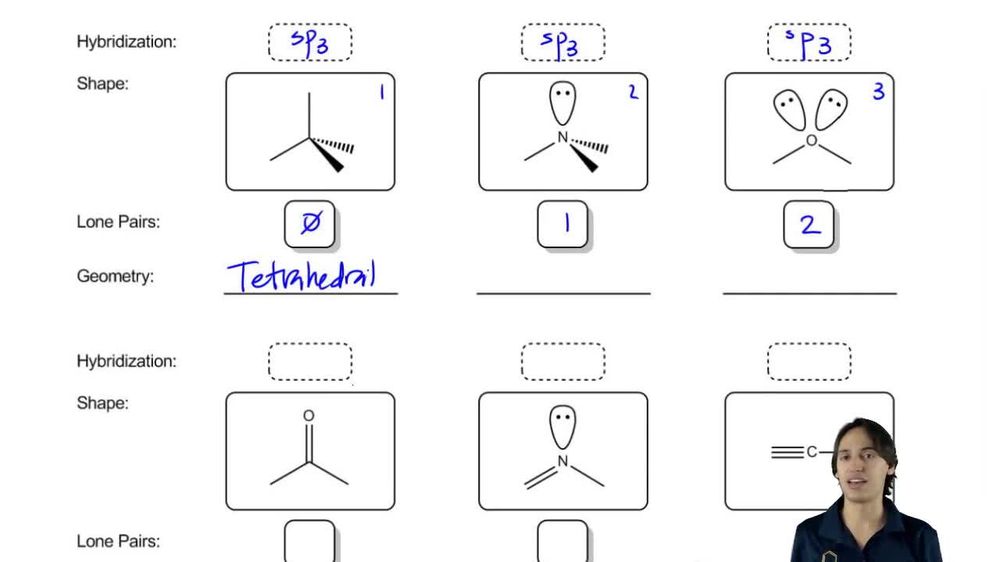
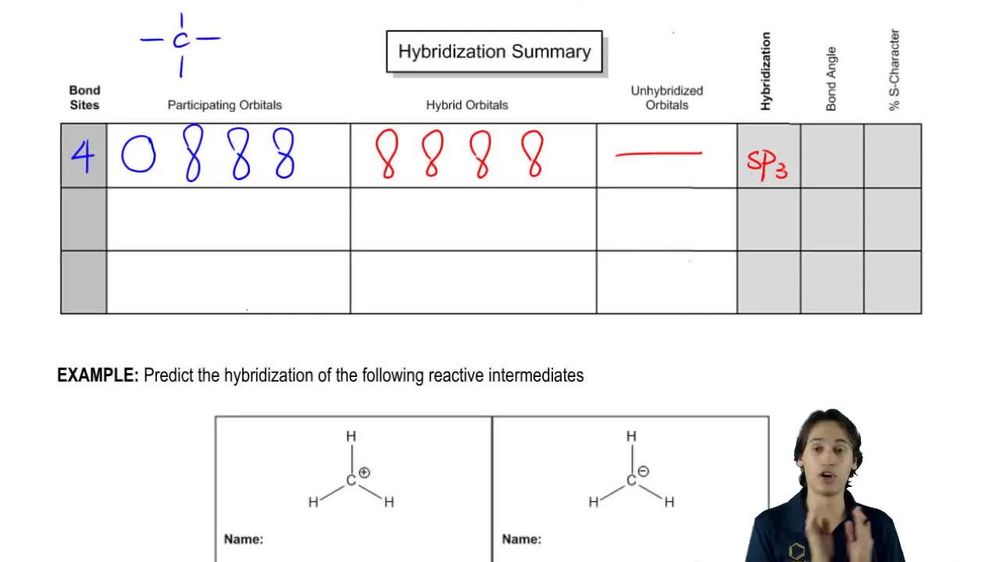
Step 1: Understand the hybridization of the central carbon atom in each species. The methyl cation (CH₃⁺) has a positively charged carbon atom with only three bonding pairs and no lone pairs, indicating sp² hybridization. The methyl radical (CH₃•) has three bonding pairs and one unpaired electron, also suggesting sp² hybridization. The methyl anion (CH₃⁻) has three bonding pairs and one lone pair, indicating sp³ hybridization.
Step 2: Recall the bond angles associated with each hybridization. For sp² hybridization, the bond angles are approximately 120°, as the electron pairs are arranged in a trigonal planar geometry. For sp³ hybridization, the bond angles are approximately 109.5°, as the electron pairs are arranged in a tetrahedral geometry.
Step 3: Apply the bond angle predictions to each species. For the methyl cation (CH₃⁺), the sp² hybridization leads to bond angles of approximately 120°. For the methyl radical (CH₃•), the sp² hybridization also leads to bond angles of approximately 120°. For the methyl anion (CH₃⁻), the sp³ hybridization leads to bond angles of approximately 109.5°.
Step 4: Consider any deviations from ideal bond angles due to electronic effects. In the methyl anion (CH₃⁻), the lone pair on the carbon atom may slightly compress the bond angles below the ideal tetrahedral angle of 109.5°.
Step 5: Summarize the bond angle predictions: The methyl cation and methyl radical both have bond angles of approximately 120° due to sp² hybridization, while the methyl anion has bond angles close to 109.5° due to sp³ hybridization, with potential slight compression due to the lone pair.
Verified video answer for a similar problem:
This video solution was recommended by our tutors as helpful for the problem above
Video duration:
2m
Play a video:
0 Comments
Key Concepts
Here are the essential concepts you must grasp in order to answer the question correctly.
Hybridization
Hybridization is the concept of mixing atomic orbitals to form new hybrid orbitals that can accommodate bonding. In organic chemistry, it helps predict the geometry and bond angles of molecules. For example, sp3 hybridization leads to tetrahedral geometry with bond angles of approximately 109.5°, while sp2 and sp hybridizations correspond to trigonal planar (120°) and linear (180°) geometries, respectively.
Molecular geometry refers to the three-dimensional arrangement of atoms within a molecule. It is influenced by the number of bonding pairs and lone pairs of electrons around the central atom. Understanding molecular geometry is crucial for predicting bond angles, as different geometries (like tetrahedral, trigonal planar, and linear) dictate specific angles between bonds.
The presence of a charge on a molecule can significantly alter its geometry and bond angles. Cations (positively charged) tend to have smaller bond angles due to increased electron density around the central atom, while anions (negatively charged) can lead to larger bond angles due to repulsion from additional electron pairs. This concept is essential for predicting the bond angles in species like the methyl cation, radical, and anion.