For each of the following structures, which staggered Newman projection skeleton from Assessment 3.51 should you draw first to show what is seen when looking down the indicated bond? (d) <IMAGE>
Verified step by step guidance
1
Identify the bond in the given structure that you are instructed to look down. This is typically specified in the problem (e.g., C1-C2 or C2-C3). Ensure you understand which atoms are connected by this bond.
Orient the molecule in your mind or on paper so that you are looking directly down the specified bond. The front carbon (closer to you) and the back carbon (further away) will form the basis of the Newman projection.
Determine the substituents attached to the front carbon. These substituents will be represented as three groups radiating out from the center of the front carbon in the Newman projection.
Determine the substituents attached to the back carbon. These substituents will also be represented as three groups radiating out from the center of the back carbon in the Newman projection, but they will be positioned behind the front carbon.
Draw the staggered Newman projection by arranging the substituents on the front and back carbons such that the groups on the back carbon are positioned in the gaps between the groups on the front carbon. This arrangement minimizes torsional strain and represents the staggered conformation.
Verified video answer for a similar problem:
This video solution was recommended by our tutors as helpful for the problem above
Play a video:
0 Comments
Key Concepts
Here are the essential concepts you must grasp in order to answer the question correctly.
Newman Projections
Newman projections are a way to visualize the conformation of a molecule by looking straight down a bond connecting two carbon atoms. This representation helps in understanding the spatial arrangement of substituents around the bond, which is crucial for analyzing steric interactions and torsional strain in organic compounds.
In a Newman projection, staggered conformations occur when the substituents on adjacent carbons are positioned as far apart as possible, minimizing steric hindrance. In contrast, eclipsed conformations have substituents aligned with each other, leading to increased repulsion and higher energy states. Recognizing these conformations is essential for predicting the stability of different molecular arrangements.
The dihedral angle is the angle between two planes formed by four atoms in a molecule, specifically the angle between the bonds on the front and back carbon atoms in a Newman projection. This angle is critical for determining the conformation of the molecule, as it influences the interactions between substituents and can affect the overall energy and reactivity of the compound.

 Verified step by step guidance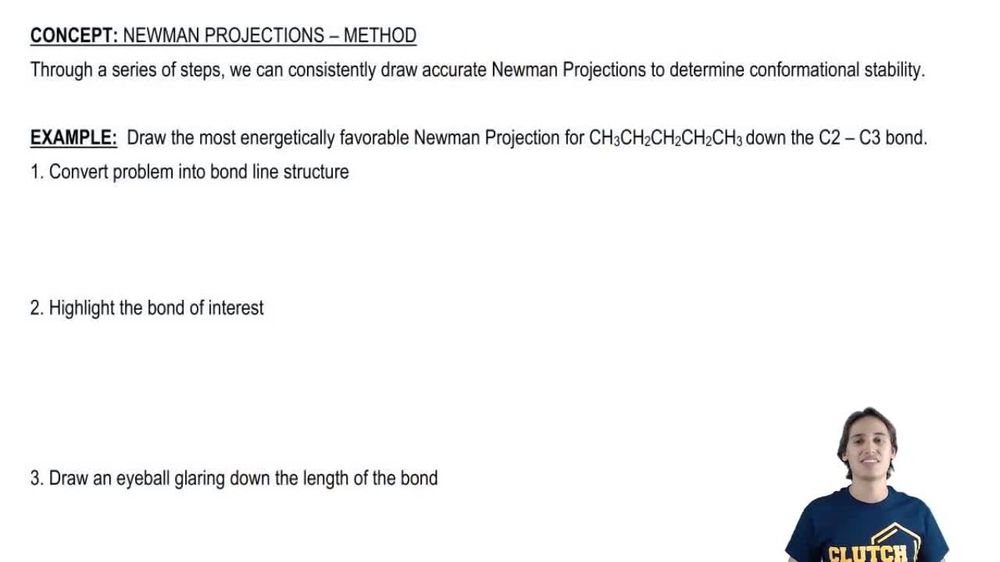
 00:34
00:34