Give the structures of the products you would expect when each alcohol reacts with (1) HCl, ZnCl2; (2) HBr; (3) PBr3; (4) P/I2; and (5) SOCl2. (a) butan-1-ol (b) 2-methylbutan-2-ol
Verified step by step guidance
1
Step 1: Understand the reactivity of alcohols with the given reagents. Alcohols can undergo substitution reactions where the hydroxyl group (-OH) is replaced by a halide (Cl, Br, or I). The reactivity depends on the type of alcohol (primary, secondary, or tertiary) and the reagent used.
Step 2: For (a) butan-1-ol (a primary alcohol): (1) With HCl and ZnCl₂ (Lucas reagent), the reaction proceeds via an SN2 mechanism, forming 1-chlorobutane. (2) With HBr, the reaction also proceeds via an SN2 mechanism, forming 1-bromobutane. (3) With PBr₃, the hydroxyl group is replaced by bromine, forming 1-bromobutane. (4) With P/I₂, iodine replaces the hydroxyl group, forming 1-iodobutane. (5) With SOCl₂, the hydroxyl group is replaced by chlorine, forming 1-chlorobutane.
Step 3: For (b) 2-methylbutan-2-ol (a tertiary alcohol): (1) With HCl and ZnCl₂, the reaction proceeds via an SN1 mechanism due to the stability of the tertiary carbocation, forming 2-chloro-2-methylbutane. (2) With HBr, the reaction also proceeds via an SN1 mechanism, forming 2-bromo-2-methylbutane. (3) With PBr₃, tertiary alcohols generally do not react efficiently with PBr₃ due to steric hindrance. (4) With P/I₂, tertiary alcohols generally do not react efficiently for the same reason. (5) With SOCl₂, the reaction forms 2-chloro-2-methylbutane.
Step 4: Write the chemical equations for each reaction to visualize the transformations. For example, for butan-1-ol with HCl and ZnCl₂: \( \text{CH}_3\text{CH}_2\text{CH}_2\text{CH}_2\text{OH} + \text{HCl} \xrightarrow{\text{ZnCl}_2} \text{CH}_3\text{CH}_2\text{CH}_2\text{CH}_2\text{Cl} \). Similarly, write equations for all other reactions.
Step 5: Summarize the products for each reaction and note the differences in reactivity between primary and tertiary alcohols. Primary alcohols typically undergo SN2 reactions, while tertiary alcohols favor SN1 mechanisms due to carbocation stability. This understanding helps predict the products for each reagent.
Verified video answer for a similar problem:
This video solution was recommended by our tutors as helpful for the problem above
Video duration:
7m
Play a video:
0 Comments
Key Concepts
Here are the essential concepts you must grasp in order to answer the question correctly.
Alcohol Reactivity
Alcohols are organic compounds containing a hydroxyl (-OH) group. Their reactivity is influenced by the structure of the alcohol (primary, secondary, or tertiary) and the type of reagents used. Different reagents can lead to various substitution or elimination reactions, resulting in different products. Understanding the reactivity of alcohols is crucial for predicting the outcomes of their reactions with acids and halogenating agents.
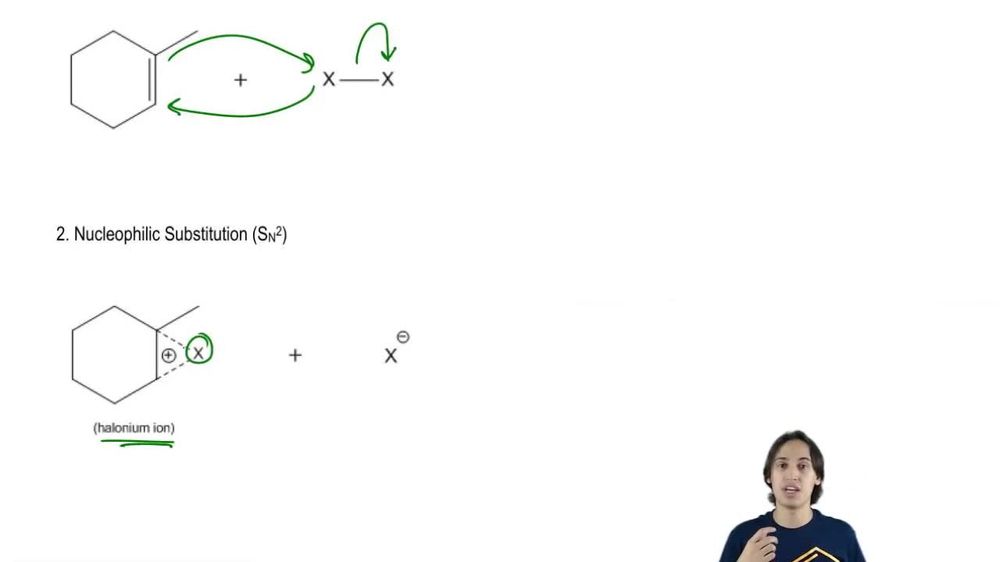
Nucleophilic substitution is a fundamental reaction mechanism in organic chemistry where a nucleophile replaces a leaving group in a molecule. The two main types are SN1 and SN2 mechanisms. SN1 involves a two-step process with a carbocation intermediate, while SN2 is a one-step process where the nucleophile attacks the substrate simultaneously as the leaving group departs. The choice of mechanism depends on the structure of the alcohol and the nature of the nucleophile.
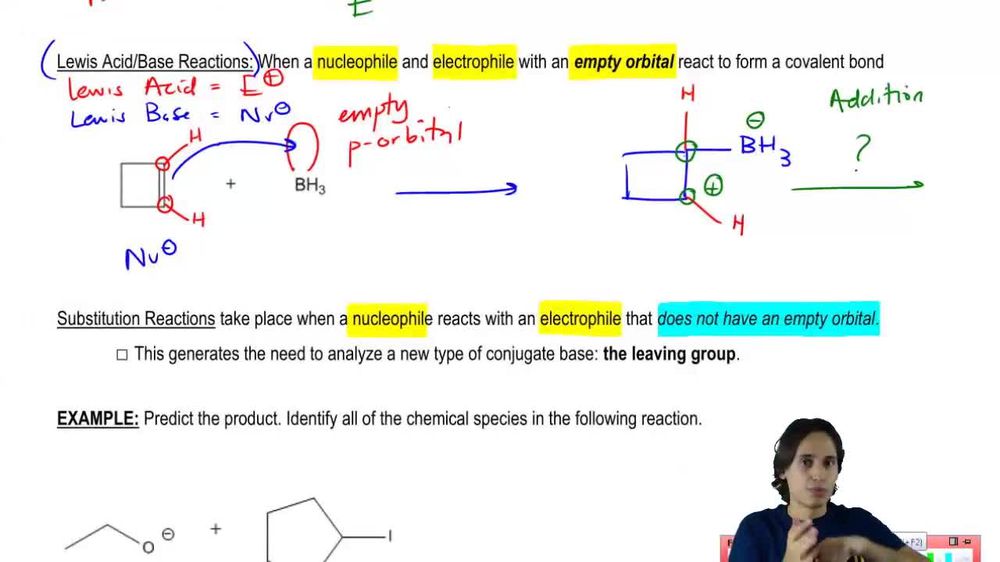
Nucleophiles and Electrophiles can react in Substitution Reactions.
Halogenation of Alcohols
Halogenation refers to the introduction of halogen atoms into organic compounds, often replacing the hydroxyl group in alcohols. Different reagents, such as HCl, HBr, PBr3, and SOCl2, can be used for this purpose, each yielding different halides. The choice of reagent affects the reaction pathway and the type of halide produced, which is essential for predicting the products when alcohols react with these halogenating agents.

 7:37 minutes
 Verified step by step guidance
 01:01
01:01