The trimethylsilyl (TMS) group, used as a protecting group for alcohols, can also be used a protecting group for terminal alkynes. Show how TMS-acetylene could be used to link together two aryl halides using the Sonogashira reaction. [Hint: Deprotection of the TMS-acetylene can be done using KF in H₂O.]
Verified step by step guidance
1
Identify the two aryl halides involved in the reaction: one is a brominated nitrobenzene and the other is an iodinated phenol ether.
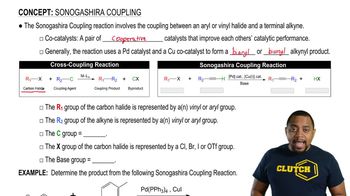
Recognize that the Sonogashira reaction is a coupling reaction between an aryl or vinyl halide and a terminal alkyne, catalyzed by palladium and copper co-catalysts.
Use TMS-acetylene as the alkyne component. The TMS group protects the terminal alkyne, preventing unwanted side reactions during the initial stages.
Perform the Sonogashira coupling reaction between the iodinated phenol ether and the TMS-protected acetylene in the presence of a palladium catalyst and a copper co-catalyst to form the TMS-protected alkyne-aryl ether intermediate.
Deprotect the TMS group using KF in H₂O to yield the final product, which is the coupled aryl-alkyne-aryl ether structure, completing the linkage of the two aryl halides.
Verified video answer for a similar problem:
This video solution was recommended by our tutors as helpful for the problem above
Video duration:
6m
Play a video:
0 Comments
Key Concepts
Here are the essential concepts you must grasp in order to answer the question correctly.
Trimethylsilyl (TMS) Group
The trimethylsilyl (TMS) group is a common protecting group in organic synthesis, particularly for alcohols and terminal alkynes. It enhances the stability and reactivity of these functional groups, allowing for selective reactions without interference. The TMS group can be removed under mild conditions, making it a versatile choice in multi-step syntheses.
The Sonogashira reaction is a cross-coupling reaction that links terminal alkynes with aryl or vinyl halides in the presence of a palladium catalyst and a base. This reaction is significant in organic synthesis for forming carbon-carbon bonds, particularly in the construction of complex molecules. The use of TMS-acetylene in this reaction allows for the selective coupling of aryl halides while protecting the alkyne functionality.
Deprotection refers to the removal of a protecting group to restore the original functional group. In the case of TMS-acetylene, deprotection can be achieved using potassium fluoride (KF) in water, which cleaves the TMS group and regenerates the terminal alkyne. This step is crucial after the Sonogashira reaction to obtain the desired product with free alkyne functionality.