
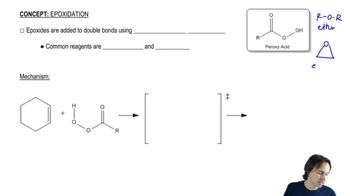

Addition to an epoxide occurs via an SN2 reaction, but the stereochemistry of the epoxide is retained in the following reaction. Why?
Verified step by step guidance
1
Understand the mechanism of the reaction: The addition to an epoxide occurs via an Sₙ2 mechanism, which involves a backside attack by the nucleophile. This means the nucleophile attacks the less sterically hindered carbon of the epoxide ring, leading to ring opening.
Recognize the stereochemical implications of the Sₙ2 mechanism: In a typical Sₙ2 reaction, the stereochemistry at the carbon being attacked is inverted due to the backside attack. However, in the case of an epoxide, the stereochemistry of the product depends on the orientation of the epoxide ring during the attack.
Consider the retention of stereochemistry: The retention of stereochemistry in this reaction occurs because the nucleophile attacks the epoxide in such a way that the stereochemical configuration of the substituents on the epoxide is preserved. This happens because the epoxide ring is planar and the attack occurs in a concerted manner, maintaining the relative spatial arrangement of the groups.
Account for the reaction conditions: The reaction conditions, such as the solvent and the nature of the nucleophile, can influence the stereochemical outcome. For example, if the reaction occurs in a non-polar solvent, the nucleophile may approach the epoxide in a way that minimizes steric hindrance while preserving the stereochemistry.
Summarize the key point: The stereochemistry of the epoxide is retained because the nucleophile attacks in a manner that preserves the relative configuration of the substituents on the epoxide, even though the Sₙ2 mechanism typically involves inversion of configuration at the site of attack.
Verified video answer for a similar problem:
This video solution was recommended by our tutors as helpful for the problem above
Play a video:
0 Comments
Key Concepts
Here are the essential concepts you must grasp in order to answer the question correctly.
Epoxide Structure
Epoxides are three-membered cyclic ethers characterized by a highly strained ring structure. This strain makes them reactive, particularly towards nucleophiles. The oxygen atom in the epoxide contributes to the ring's reactivity, allowing for nucleophilic attack at the carbon atoms adjacent to the oxygen.
The Sₙ2 (bimolecular nucleophilic substitution) mechanism involves a nucleophile attacking an electrophilic carbon atom from the opposite side of the leaving group, resulting in inversion of configuration. This concerted process means that the stereochemistry of the substrate is directly affected by the approach of the nucleophile, leading to a retention of stereochemistry in certain cases, such as with epoxides.
In the context of epoxide reactions, stereochemistry retention occurs when the nucleophile attacks the less hindered carbon atom of the epoxide. Since the epoxide's ring structure forces the nucleophile to approach from the backside, the original stereochemical configuration is preserved, leading to a product that maintains the stereochemical characteristics of the starting epoxide.