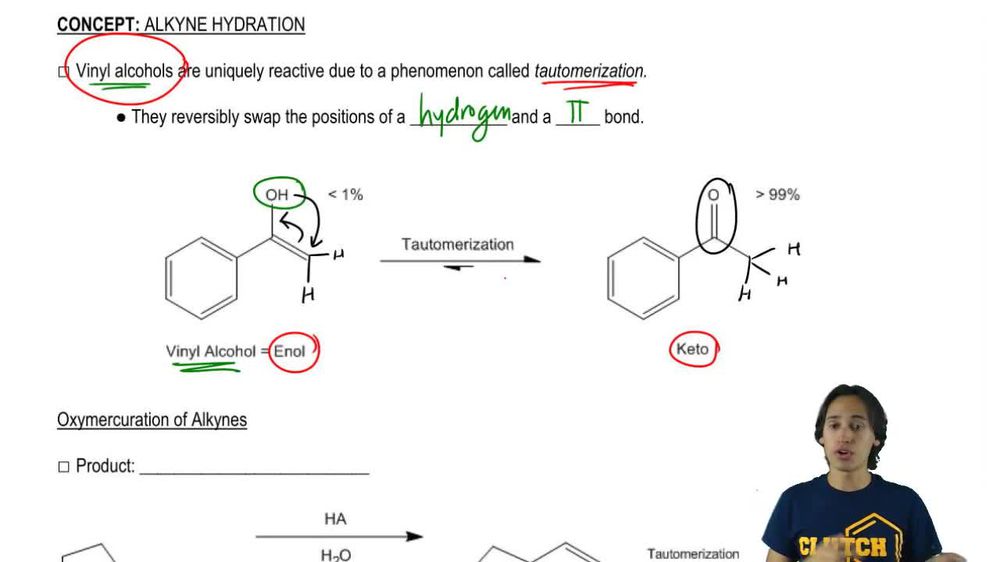
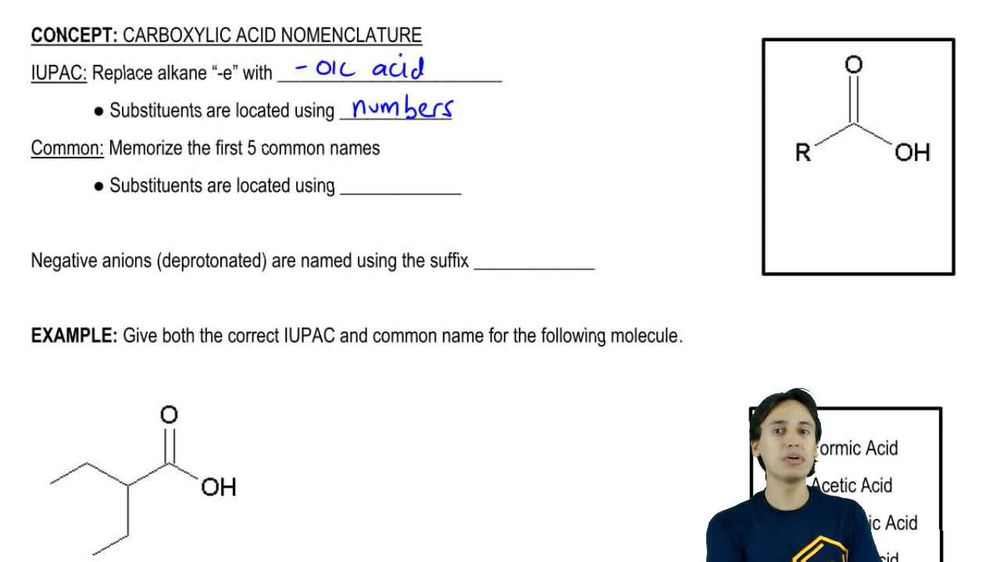
Oxidative cleavages can help to determine the positions of the triple bonds in alkynes. (b) An unknown alkyne undergoes oxidative cleavage to give the following triacid plus one equivalent of propionic acid. Propose a structure for the alkyne.
Verified step by step guidance
1
Step 1: Understand the reaction conditions. The unknown alkyne undergoes oxidative cleavage using ozone (O₃) at -78°C followed by hydrolysis with water (H₂O). This reaction breaks the triple bond in the alkyne, forming carboxylic acids as products.
Step 2: Analyze the products. The reaction yields two products: (1) a triacid with the structure HOOC-(CH₂)₇-CH(COOH)-COOH and (2) one equivalent of propionic acid (CH₃CH₂COOH). This indicates that the alkyne has two triple bonds, as oxidative cleavage of each triple bond produces carboxylic acids.
Step 3: Deduce the positions of the triple bonds. The triacid product suggests that one triple bond is located such that cleavage results in a molecule with three carboxylic acid groups. The propionic acid indicates that the second triple bond is located such that cleavage produces a three-carbon carboxylic acid.
Step 4: Reconstruct the alkyne structure. To form the triacid, the alkyne must have a segment with a chain of 7 methylene groups (CH₂) between the triple bonds. The propionic acid suggests that the second triple bond is at the end of the chain, adjacent to a methyl group.
Step 5: Combine the information. The unknown alkyne structure can be proposed by placing the two triple bonds in positions that align with the cleavage products: one triple bond near the center of the chain to form the triacid and the other at the end to form propionic acid.
Verified video answer for a similar problem:
This video solution was recommended by our tutors as helpful for the problem above
Video duration:
5m
Play a video:
0 Comments
Key Concepts
Here are the essential concepts you must grasp in order to answer the question correctly.
Oxidative Cleavage
Oxidative cleavage is a reaction that involves the breaking of carbon-carbon double or triple bonds in the presence of oxidizing agents, such as ozone (O3). In alkynes, this process results in the formation of carboxylic acids or ketones, depending on the structure of the alkyne. The reaction typically occurs under controlled conditions, such as low temperatures, to prevent further reactions.
Alkynes are hydrocarbons that contain at least one carbon-carbon triple bond, characterized by the general formula CnH2n-2. The position of the triple bond significantly influences the reactivity and the products formed during reactions, including oxidative cleavage. Understanding the structure of alkynes is crucial for predicting the outcome of reactions and determining the resulting products.
During oxidative cleavage of alkynes, the reaction typically yields carboxylic acids as products. In this case, the cleavage of the triple bond leads to the formation of a triacid and propionic acid, indicating that the original alkyne had specific substituents that contributed to these products. Recognizing the structure of the resulting acids helps in deducing the original alkyne's structure.