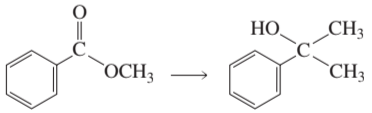
How can the following compounds be prepared from the given starting materials? a.
Verified step by step guidance
1
Step 1: Analyze the starting material and the target compound. The starting material is a cyclopentanone derivative with a methoxy group attached to the carbonyl carbon. The target compound is a cyclopentane derivative with a tertiary alcohol group and two methyl groups attached to the same carbon.
Step 2: Recognize the transformation required. The reaction involves converting the carbonyl group into a tertiary alcohol and introducing two methyl groups. This suggests a nucleophilic addition reaction followed by reduction.
Step 3: Identify the reagent for methyl addition. Use a Grignard reagent, such as methyl magnesium bromide (CH₃MgBr), to add two methyl groups to the carbonyl carbon. This step forms a tertiary alcohol intermediate.
Step 4: Consider the reaction mechanism. The Grignard reagent attacks the electrophilic carbonyl carbon, breaking the double bond and forming a new C-C bond. The intermediate is then protonated to yield the tertiary alcohol.
Step 5: Ensure proper reaction conditions. Perform the reaction in an anhydrous ether solvent to stabilize the Grignard reagent and avoid side reactions. After the addition, use an acid workup (e.g., HCl or H₂O) to protonate the intermediate and complete the reaction.
Verified video answer for a similar problem:
This video solution was recommended by our tutors as helpful for the problem above
Video duration:
3m
Play a video:
0 Comments
Key Concepts
Here are the essential concepts you must grasp in order to answer the question correctly.
Nucleophilic Acyl Substitution
Nucleophilic acyl substitution is a fundamental reaction in organic chemistry where a nucleophile attacks the carbonyl carbon of an acyl compound, leading to the replacement of a leaving group. This mechanism is crucial for transforming carboxylic acid derivatives into other functional groups, such as alcohols or amines, by introducing new substituents while maintaining the carbonyl structure.
Nucleophiles and Electrophiles can react in Substitution Reactions.
Reactivity of Carbonyl Compounds
Carbonyl compounds, such as aldehydes and ketones, exhibit unique reactivity due to the polarized carbon-oxygen double bond. The carbon atom is electrophilic, making it susceptible to nucleophilic attack. Understanding the reactivity patterns of these compounds is essential for predicting the outcomes of organic reactions, including the formation of alcohols from acyl derivatives.
Stereochemistry refers to the spatial arrangement of atoms in molecules and how this affects their chemical behavior. In reactions involving chiral centers, such as the one depicted, the stereochemical outcome can lead to different products. Recognizing the importance of stereochemistry is vital for understanding reaction mechanisms and predicting the configuration of the final products.