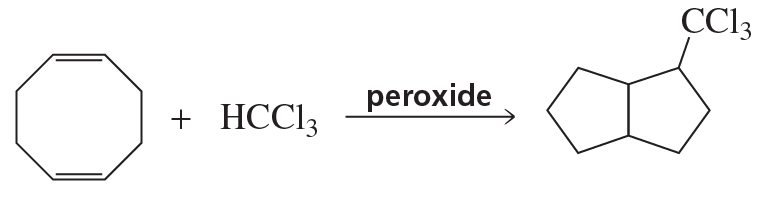
Identify the type of reaction: Begin by analyzing the reactants and products to determine the reaction type (e.g., substitution, elimination, addition, etc.). Look for functional groups and changes in bonding patterns to guide your understanding.
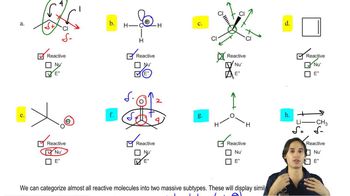
Determine the reactive sites: Locate the electrophilic and nucleophilic centers in the reactants. Electrophiles are electron-deficient species, while nucleophiles are electron-rich species.
Propose the first step: Identify the initial interaction between the nucleophile and electrophile. For example, if the reaction involves a nucleophilic attack, show how the nucleophile donates a pair of electrons to the electrophile, forming a new bond.
Account for intermediates: If the reaction proceeds through intermediates (e.g., carbocations, carbanions, or radicals), describe their formation and stability. Consider resonance, inductive effects, and hyperconjugation to explain intermediate stability.
Complete the mechanism: Show subsequent steps, such as bond-breaking or bond-forming events, until the final product is formed. Ensure that all charges are balanced and that all lone pairs and formal charges are accounted for in the mechanism.
Verified video answer for a similar problem:
This video solution was recommended by our tutors as helpful for the problem above
Video duration:
10m
Play a video:
0 Comments
Key Concepts
Here are the essential concepts you must grasp in order to answer the question correctly.
Reaction Mechanism
A reaction mechanism is a step-by-step description of how a chemical reaction occurs at the molecular level. It outlines the sequence of elementary steps, including bond breaking and formation, and the intermediates formed during the reaction. Understanding the mechanism helps predict the products and the conditions under which the reaction occurs.
Nucleophiles are species that donate an electron pair to form a chemical bond, while electrophiles are electron-deficient species that accept an electron pair. Identifying these roles in a reaction is crucial for proposing a mechanism, as it determines how reactants interact and the pathway the reaction follows.
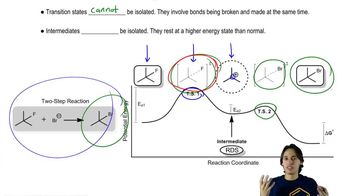
Transition states are high-energy states that occur during the transformation of reactants to products, representing the point of maximum energy along the reaction pathway. Intermediates are species that are formed and consumed during the reaction but are not present in the final products. Understanding these concepts is essential for accurately depicting the mechanism and energy changes involved.