The bulky borane 9-BBN was developed to enhance the selectivity of hydroboration. In this example, 9-BBN adds to the less hindered carbon with 99.3% regioselectivity, compared with only 57% for diborane. a. Show the two organic products generated when the trialkylborane is oxidized with H2O2/NaOH.
Verified step by step guidance
1
Step 1: Analyze the reaction mechanism. The hydroboration reaction involves the addition of 9-BBN (a bulky borane) to the alkene. Due to steric hindrance, 9-BBN selectively adds to the less hindered carbon of the double bond, forming a trialkylborane intermediate.
Step 2: Identify the regioselectivity. The image indicates that 9-BBN adds to the less hindered carbon with 99.3% regioselectivity. This means the boron atom attaches to the less substituted carbon of the double bond, while the hydrogen attaches to the more substituted carbon.
Step 3: Understand the oxidation step. The trialkylborane intermediate is oxidized using hydrogen peroxide (H₂O₂) and sodium hydroxide (NaOH). This oxidation converts the boron-carbon bond into a hydroxyl group (-OH), resulting in the formation of alcohols.
Step 4: Predict the products. The regioselectivity of the hydroboration step determines the position of the hydroxyl group in the final products. The major product will have the hydroxyl group on the less substituted carbon, while the minor product (if any) will have the hydroxyl group on the more substituted carbon.
Step 5: Draw the two organic products. The major product will be the alcohol with the hydroxyl group on the less substituted carbon, and the minor product (if formed) will have the hydroxyl group on the more substituted carbon. Use the provided structure to visualize the placement of the hydroxyl groups.
Verified video answer for a similar problem:
This video solution was recommended by our tutors as helpful for the problem above
Video duration:
1m
Play a video:
0 Comments
Key Concepts
Here are the essential concepts you must grasp in order to answer the question correctly.
Hydroboration
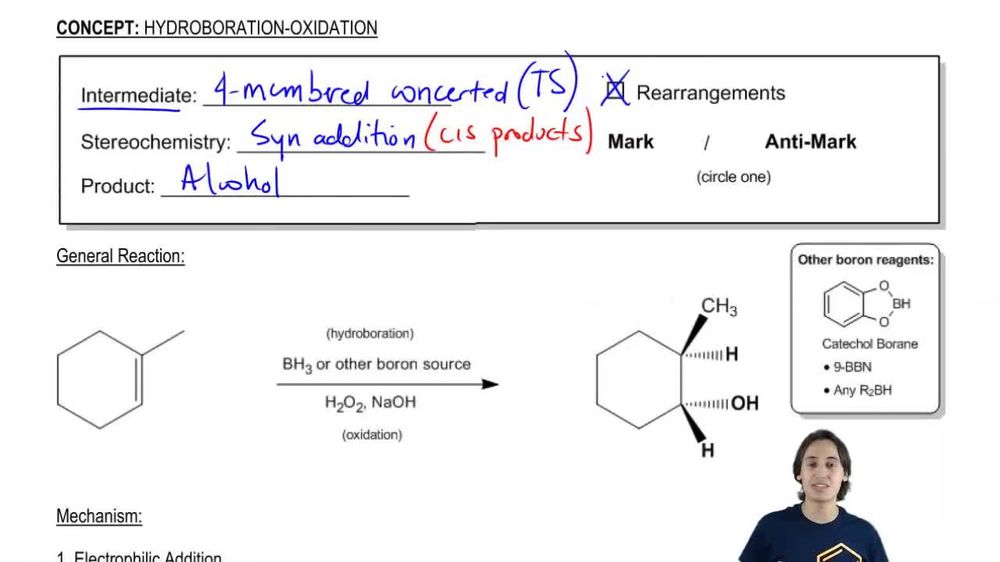
Hydroboration is a chemical reaction that involves the addition of borane (BH3) or its derivatives to alkenes, resulting in the formation of trialkylboranes. This reaction proceeds via a concerted mechanism, where the boron atom adds to the less hindered carbon of the double bond, leading to regioselectivity. The use of bulky boranes like 9-BBN enhances this selectivity, allowing for the preferential formation of specific isomers.
Regioselectivity refers to the preference of a chemical reaction to yield one structural isomer over others when multiple possibilities exist. In the context of hydroboration, 9-BBN demonstrates high regioselectivity (99.3%) by adding to the less sterically hindered carbon of the alkene. This property is crucial for synthesizing specific products in organic reactions, influencing the overall yield and purity of the desired compound.
The oxidation of trialkylboranes, such as those formed from hydroboration, typically involves treatment with hydrogen peroxide (H2O2) and sodium hydroxide (NaOH). This reaction converts the boron-containing compound into alcohols, effectively replacing the boron atom with a hydroxyl group. The outcome is the formation of alcohols that correspond to the original alkene's regioselectivity, thus providing insight into the reaction's mechanism and product distribution.

 1:40 minutes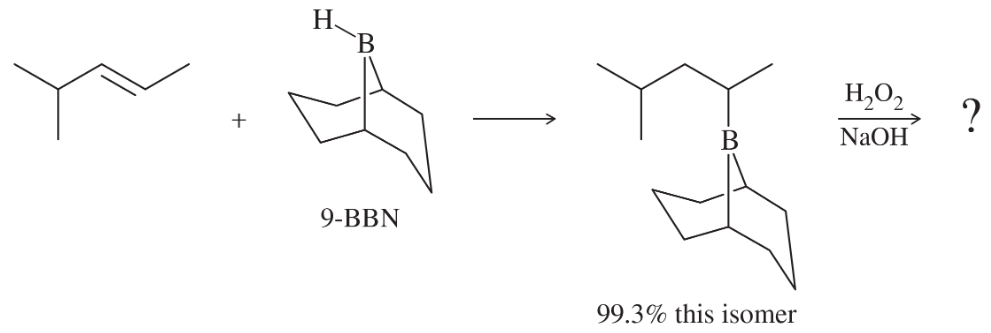
 Verified step by step guidance
 06:38
06:38