A chemistry student drew the following incorrect electron configuration for carbon. (b) Which rule wasn't followed by the student?
Verified step by step guidance
1
Step 1: Analyze the electron configuration provided in the image. The configuration shows the 1s and 2s orbitals filled correctly, but the 2p orbitals have two electrons paired in one box and the other two boxes are empty.
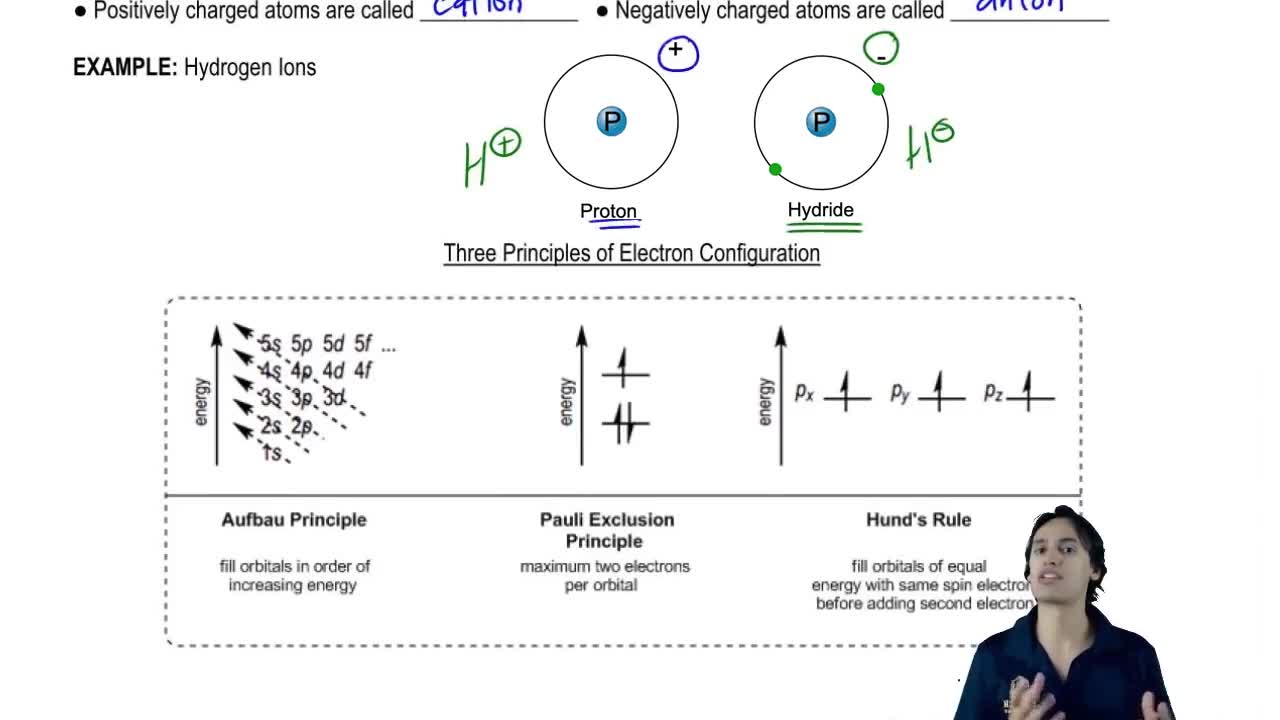
Step 2: Recall Hund's Rule, which states that electrons must occupy degenerate orbitals (orbitals of the same energy level) singly before pairing occurs. This minimizes electron repulsion and stabilizes the atom.
Step 3: Identify the mistake in the student's drawing. The student paired two electrons in one 2p orbital without first placing one electron in each of the three 2p orbitals.
Step 4: Explain the correct approach. According to Hund's Rule, the correct electron configuration for carbon's 2p orbitals should have one electron in each of the three 2p orbitals before any pairing occurs.
Step 5: Conclude that the rule violated by the student is Hund's Rule, and emphasize the importance of following this rule for accurate electron configurations.
Verified video answer for a similar problem:
This video solution was recommended by our tutors as helpful for the problem above
Video duration:
5m
Play a video:
0 Comments
Key Concepts
Here are the essential concepts you must grasp in order to answer the question correctly.
Aufbau Principle
The Aufbau Principle states that electrons occupy the lowest energy orbitals first before filling higher energy levels. For carbon, which has six electrons, the correct order of filling is 1s², 2s², and then 2p². This principle is fundamental in determining the electron configuration of elements.
The Pauli Exclusion Principle asserts that no two electrons in an atom can have the same set of four quantum numbers. This means that an orbital can hold a maximum of two electrons, which must have opposite spins. In the provided configuration, if the same orbital is shown with two electrons having the same spin, this principle is violated.
Hund's Rule states that electrons will fill degenerate orbitals (orbitals of the same energy) singly before pairing up. In the case of the 2p orbitals for carbon, the correct configuration should show one electron in each of the three 2p orbitals before any pairing occurs. This rule helps minimize electron-electron repulsion and stabilizes the atom.

 5:52 minutes
 Verified step by step guidance

 2:38
2:38