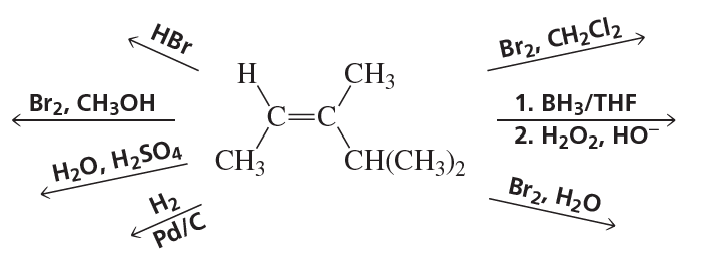
Draw the products of the following reactions, including their configurations:
Verified step by step guidance
1
Step 1: Analyze the starting material, which is a cyclohexene ring with one double bond. The reactions involve bromine (Br₂) in two different solvents: water (H₂O) for reaction A and methanol (CH₃OH) for reaction B.
Step 2: For reaction A (Br₂ in H₂O), the reaction proceeds via an electrophilic addition mechanism. Bromine adds across the double bond, forming a bromonium ion intermediate. Water acts as a nucleophile and attacks the more substituted carbon of the bromonium ion, leading to the formation of a bromohydrin. The product will have anti stereochemistry due to the backside attack of water.
Step 3: For reaction B (Br₂ in CH₃OH), the reaction also proceeds via an electrophilic addition mechanism. Bromine adds across the double bond, forming a bromonium ion intermediate. Methanol acts as a nucleophile and attacks the more substituted carbon of the bromonium ion, leading to the formation of a bromoether. The product will also have anti stereochemistry due to the backside attack of methanol.
Step 4: Draw the products for both reactions. For reaction A, the product is a bromohydrin with anti stereochemistry. For reaction B, the product is a bromoether with anti stereochemistry. Ensure to include the correct configurations in the drawings.
Step 5: Verify the stereochemistry and regiochemistry of the products. In both cases, the nucleophile (water or methanol) attacks the more substituted carbon of the bromonium ion, and the bromine ends up on the less substituted carbon. This ensures the anti addition and regioselectivity of the products.
Verified video answer for a similar problem:
This video solution was recommended by our tutors as helpful for the problem above
Video duration:
7m
Play a video:
0 Comments
Key Concepts
Here are the essential concepts you must grasp in order to answer the question correctly.
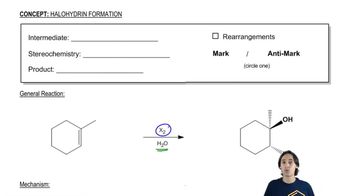
Halohydrin Formation
Halohydrin formation is a reaction where an alkene reacts with a halogen (like Br2) in the presence of water or alcohol, leading to the formation of a halohydrin. In this process, one of the halogen atoms adds to one carbon of the double bond, while a hydroxyl or alkoxy group adds to the other carbon, resulting in a compound with both a halogen and a hydroxyl or alkoxy group.
Regioselectivity refers to the preference of a chemical reaction to yield one structural isomer over others when multiple possibilities exist. In the context of halohydrin formation, the regioselectivity is influenced by the stability of the carbocation intermediate formed during the reaction, which can lead to different products depending on the substituents on the benzene ring.
Stereochemistry involves the study of the spatial arrangement of atoms in molecules and how this affects their chemical behavior. In the case of halohydrin formation, the stereochemistry of the product is important, as the addition of the halogen and hydroxyl or alkoxy group can lead to different stereoisomers, which may have distinct physical and chemical properties.