For each pair, predict the stronger nucleophile in the SN2 reaction (using an alcohol as the solvent). Explain your prediction. g. (CH3)2CHO– or CH3CH2CH2O– h. I– or Cl–
Verified step by step guidance
1
Step 1: Understand the SN2 reaction mechanism. In an SN2 reaction, the nucleophile attacks the electrophilic carbon in a single concerted step, displacing the leaving group. The strength of the nucleophile plays a critical role in determining the reaction rate.
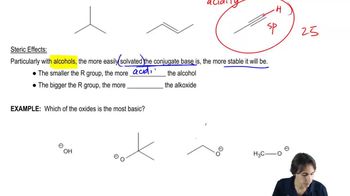
Step 2: Analyze the nucleophiles in part (g): (CH3)2CHO⁻ (a secondary alkoxide) and CH3CH2CH2O⁻ (a primary alkoxide). In general, primary alkoxides are less sterically hindered than secondary alkoxides, making them stronger nucleophiles in SN2 reactions. Additionally, both nucleophiles are negatively charged, so steric hindrance is the key factor here.
Step 3: Analyze the nucleophiles in part (h): I⁻ and Cl⁻. In polar protic solvents like alcohols, larger anions are better nucleophiles because they are less solvated and can attack the electrophile more effectively. I⁻ is larger than Cl⁻, so it is the stronger nucleophile in this case.
Step 4: Consider the solvent effect. Alcohols are polar protic solvents, which stabilize smaller, more electronegative anions (like Cl⁻) through hydrogen bonding. This stabilization reduces their nucleophilicity compared to larger anions (like I⁻). Similarly, steric hindrance in alkoxides is exacerbated in polar protic solvents, further favoring less hindered nucleophiles.
Step 5: Summarize the predictions. For part (g), CH3CH2CH2O⁻ is the stronger nucleophile due to less steric hindrance. For part (h), I⁻ is the stronger nucleophile because it is larger and less solvated in the polar protic solvent.
Verified video answer for a similar problem:
This video solution was recommended by our tutors as helpful for the problem above
Video duration:
7m
Play a video:
0 Comments
Key Concepts
Here are the essential concepts you must grasp in order to answer the question correctly.
Nucleophilicity
Nucleophilicity refers to the ability of a species to donate an electron pair to an electrophile during a chemical reaction. In SN2 reactions, stronger nucleophiles are more reactive and can effectively attack the electrophilic carbon. Factors influencing nucleophilicity include charge, electronegativity, and steric hindrance, with negatively charged species generally being stronger nucleophiles than their neutral counterparts.
The choice of solvent can significantly impact the rate and outcome of SN2 reactions. Polar protic solvents, like alcohols, can stabilize nucleophiles through hydrogen bonding, which may reduce their reactivity. In contrast, polar aprotic solvents enhance nucleophilicity by solvation of cations while leaving anions less solvated, thus making them more available for reaction.
Steric hindrance refers to the crowding around a reactive center that can impede the approach of nucleophiles in a reaction. In SN2 mechanisms, sterically hindered nucleophiles or substrates slow down the reaction rate. For example, a bulky nucleophile will be less effective in attacking a substrate compared to a less hindered one, making steric factors crucial in predicting nucleophilicity.