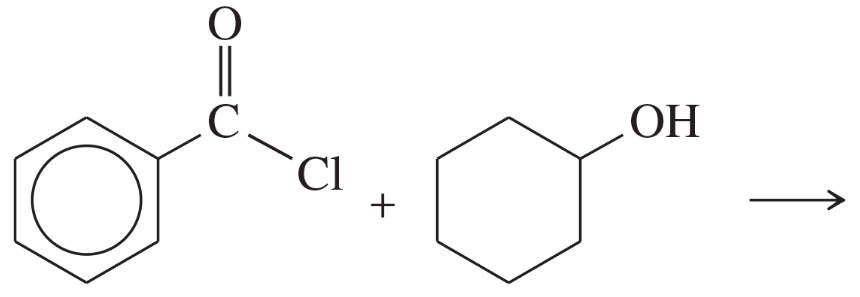
Predict the products of the following reactions. (a)
Verified step by step guidance
1
Step 1: Identify the functional groups in the reactants. The first reactant is benzoyl chloride (C6H5COCl), which contains an acyl chloride group. The second reactant is cyclohexanol, which contains a hydroxyl (-OH) group.
Step 2: Recognize the type of reaction. This is a nucleophilic acyl substitution reaction, where the hydroxyl group of cyclohexanol acts as a nucleophile and attacks the carbonyl carbon of benzoyl chloride.
Step 3: Describe the mechanism. The nucleophilic attack occurs as the lone pair of electrons on the oxygen atom of the hydroxyl group attacks the electrophilic carbonyl carbon of benzoyl chloride. This leads to the formation of a tetrahedral intermediate.
Step 4: Explain the elimination step. The tetrahedral intermediate collapses, expelling the chloride ion (Cl⁻) as a leaving group and forming an ester bond between the benzoyl group and cyclohexanol.
Step 5: Predict the product. The final product is cyclohexyl benzoate (C6H5COO-cyclohexyl), an ester formed by the reaction of benzoyl chloride and cyclohexanol.
Verified video answer for a similar problem:
This video solution was recommended by our tutors as helpful for the problem above
Video duration:
2m
Play a video:
0 Comments
Key Concepts
Here are the essential concepts you must grasp in order to answer the question correctly.
Carboxylic Acid Derivatives
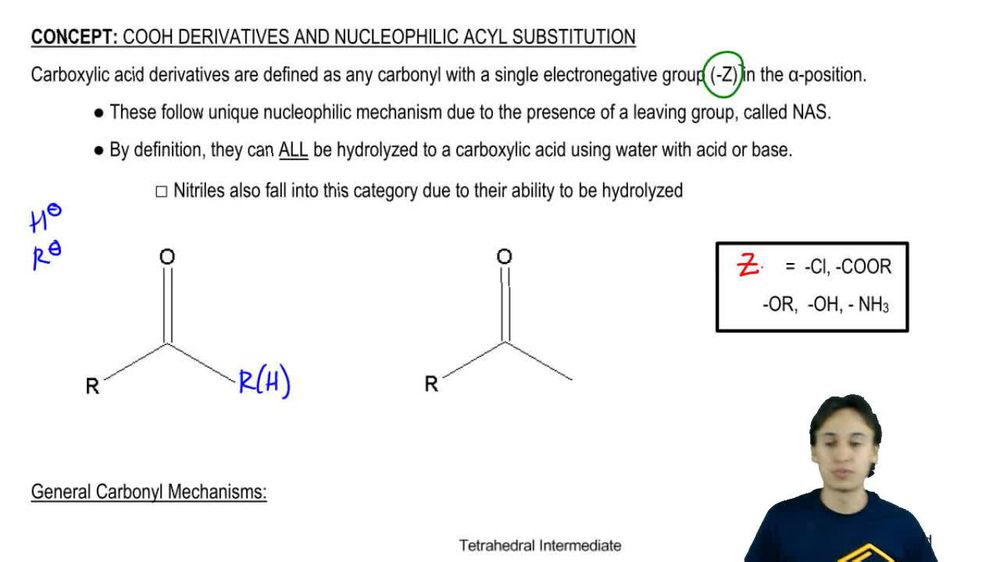
Carboxylic acid derivatives, such as acyl chlorides, esters, and anhydrides, are compounds that can be derived from carboxylic acids. They retain the carbonyl (C=O) group and can undergo nucleophilic acyl substitution reactions. In this reaction, the acyl chloride reacts with an alcohol, where the alcohol acts as a nucleophile, attacking the carbonyl carbon and leading to the formation of an ester.
Nucleophilic acyl substitution is a fundamental reaction in organic chemistry where a nucleophile attacks the electrophilic carbon of a carbonyl group in a carboxylic acid derivative. This process typically involves the formation of a tetrahedral intermediate, followed by the elimination of a leaving group, such as chloride in the case of acyl chlorides. This reaction is crucial for synthesizing esters and other derivatives.
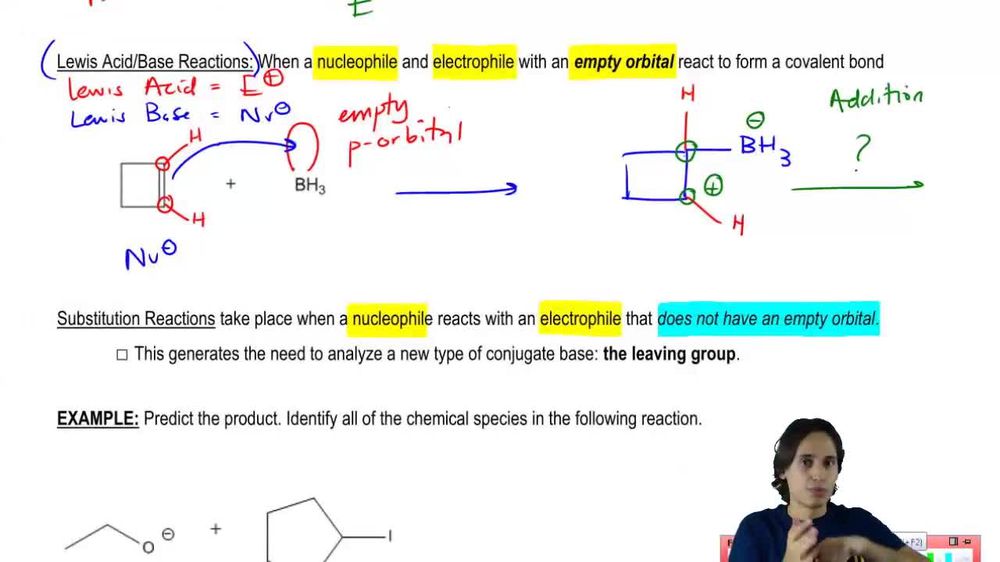
Nucleophiles and Electrophiles can react in Substitution Reactions.
Reaction Mechanism
Understanding the reaction mechanism is essential for predicting the products of organic reactions. It involves a step-by-step description of how reactants transform into products, including the movement of electrons and the formation and breaking of bonds. In this case, the mechanism will illustrate how the nucleophile (alcohol) attacks the electrophilic carbon of the acyl chloride, leading to the formation of an ester and the release of hydrochloric acid.