Explain why CH3Cl has a greater dipole moment than CH3F even though F is more electronegative than Cl.
Verified step by step guidance
1
The dipole moment (μ) is a vector quantity that depends on two factors: the magnitude of the charge separation (Δq) and the distance (d) between the charges. It is calculated using the formula: .
Fluorine (F) is more electronegative than chlorine (Cl), meaning it creates a larger charge separation (Δq) when bonded to carbon. However, the bond length (d) of the C-F bond is shorter than that of the C-Cl bond due to the smaller atomic radius of fluorine.
In CH3Cl, the C-Cl bond has a longer bond length compared to the C-F bond in CH3F. This longer bond length increases the distance (d) in the dipole moment equation, which can compensate for the slightly smaller charge separation (Δq) caused by the lower electronegativity of chlorine.
As a result, the dipole moment of CH3Cl is greater than that of CH3F because the longer bond length of the C-Cl bond contributes more significantly to the overall dipole moment, even though fluorine is more electronegative.
This demonstrates that both electronegativity and bond length must be considered when comparing dipole moments, as the dipole moment is influenced by the product of these two factors.
Verified video answer for a similar problem:
This video solution was recommended by our tutors as helpful for the problem above
Video duration:
3m
Play a video:
0 Comments
Key Concepts
Here are the essential concepts you must grasp in order to answer the question correctly.
Electronegativity
Electronegativity is a measure of an atom's ability to attract and hold onto electrons in a chemical bond. Fluorine (F) is the most electronegative element, meaning it strongly attracts electrons compared to chlorine (Cl). However, electronegativity alone does not determine the overall dipole moment of a molecule, as the molecular geometry and bond angles also play significant roles.
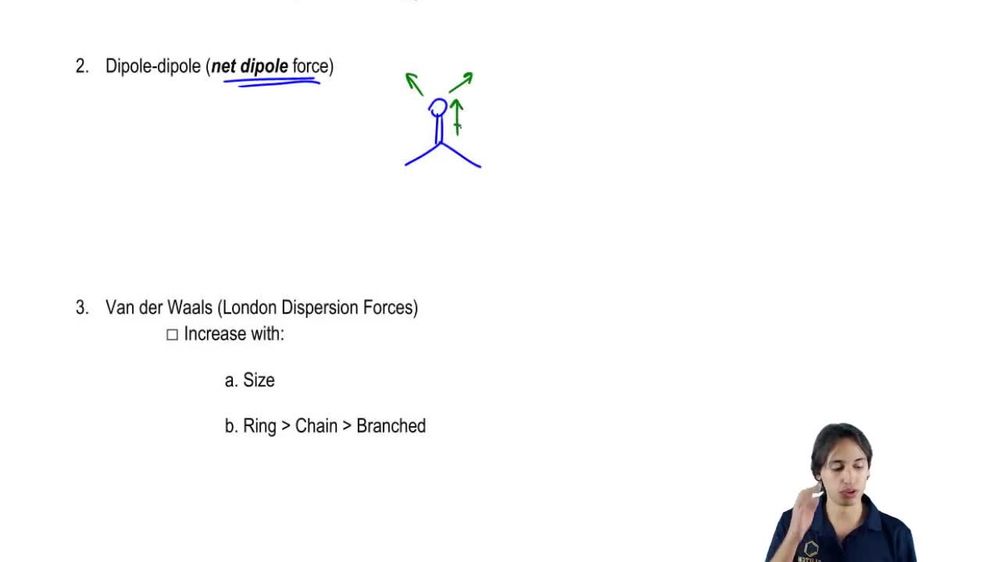
The dipole moment is a vector quantity that measures the separation of positive and negative charges in a molecule. It is influenced by both the electronegativity of the atoms involved and the geometry of the molecule. A higher dipole moment indicates a greater polarity, which can arise from the arrangement of bonds and the overall shape of the molecule, not just the electronegativity of individual atoms.
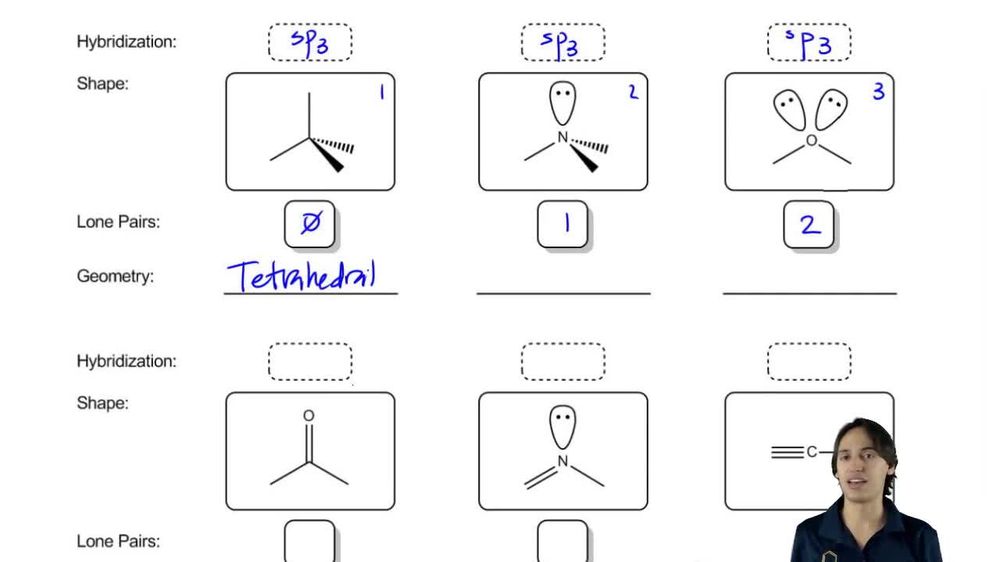
Molecular geometry refers to the three-dimensional arrangement of atoms within a molecule. In the case of CH3Cl and CH3F, the spatial arrangement of the hydrogen and halogen atoms affects how the dipole moments of the individual bonds combine. The tetrahedral shape of both molecules leads to different resultant dipole moments, with CH3Cl having a greater overall dipole moment due to the specific orientation and bond angles.