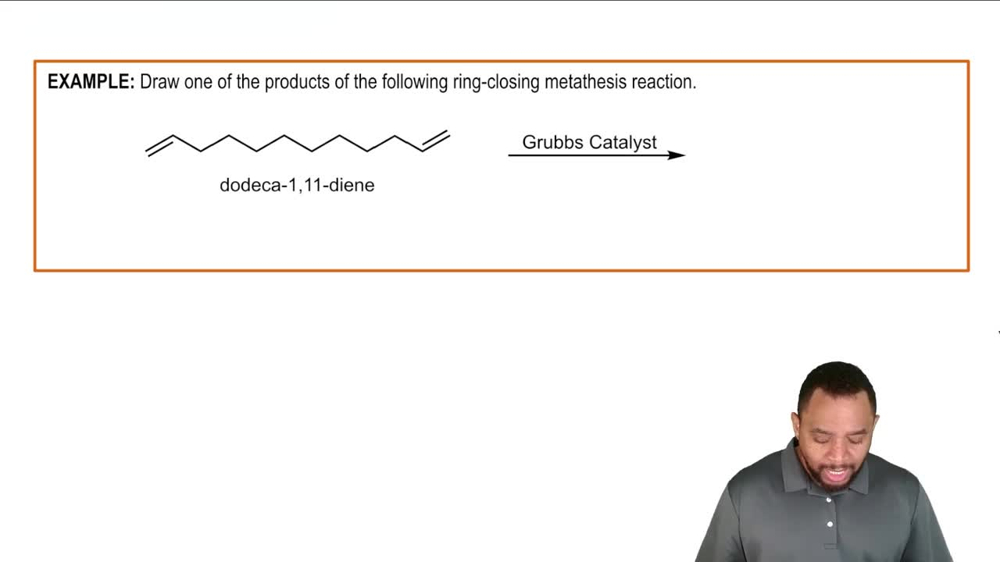
Draw the isomers for the following compounds and then name each one: a. 2-methyl-2,4-hexadiene
Verified step by step guidance
1
Step 1: Understand the structure of the given compound, 2-methyl-2,4-hexadiene. The name indicates a six-carbon chain (hex-) with two double bonds (-diene) located at positions 2 and 4. Additionally, there is a methyl group (-CH₃) attached to the second carbon.
Step 2: Begin by drawing the parent chain, which is a six-carbon chain. Place double bonds at the specified positions: one between carbons 2 and 3, and another between carbons 4 and 5. Add the methyl group to the second carbon.
Step 3: Consider the possibility of geometric (cis/trans or E/Z) isomerism due to the presence of double bonds. For each double bond, determine whether the substituents on the carbons involved in the double bond can lead to different spatial arrangements. Draw the cis and trans (or E/Z) isomers for each double bond.
Step 4: Explore structural isomerism by rearranging the position of the methyl group or the double bonds while maintaining the molecular formula (C₇H₁₂). For example, move the methyl group to a different carbon or shift the double bonds to different positions along the chain.
Step 5: Name each isomer systematically using IUPAC nomenclature rules. Ensure that the names reflect the correct positions of the double bonds, the methyl group, and the stereochemistry (if applicable).
Verified video answer for a similar problem:
This video solution was recommended by our tutors as helpful for the problem above
Video duration:
6m
Play a video:
0 Comments
Key Concepts
Here are the essential concepts you must grasp in order to answer the question correctly.
Isomerism
Isomerism refers to the phenomenon where two or more compounds have the same molecular formula but different structural arrangements or spatial orientations. In organic chemistry, isomers can be classified into structural isomers, which differ in the connectivity of atoms, and stereoisomers, which have the same connectivity but differ in the arrangement of atoms in space. Understanding isomerism is crucial for identifying and naming different compounds.
Alkenes are hydrocarbons that contain at least one carbon-carbon double bond, while dienes specifically have two double bonds. The presence of double bonds affects the reactivity and physical properties of these compounds. In the case of 2-methyl-2,4-hexadiene, recognizing its structure as a diene is essential for drawing its isomers and understanding its chemical behavior.
Nomenclature in organic chemistry is the system of naming chemical compounds based on their structure and functional groups. The International Union of Pure and Applied Chemistry (IUPAC) provides rules for naming compounds, which include identifying the longest carbon chain, numbering the chain to give the lowest possible numbers to substituents, and indicating the position of double bonds. Mastery of nomenclature is vital for accurately naming the isomers of compounds like 2-methyl-2,4-hexadiene.