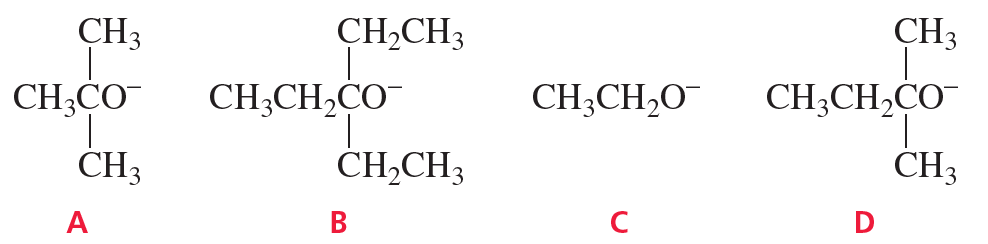
When 2-bromo-2,3-dimethylbutane reacts with a strong base, two alkenes (2,3-dimethyl-1-butene and 2,3-dimethyl-2-butene) are formed. a. Which of the bases (A, B, C, or D) would form the highest percentage of the 1-alkene? b. Which would give the highest percentage of the 2-alkene?
Verified step by step guidance
1
Step 1: Analyze the reaction mechanism. The reaction involves the elimination of HBr from 2-bromo-2,3-dimethylbutane in the presence of a strong base. This is an E2 elimination reaction, where the base abstracts a proton from a β-carbon, leading to the formation of a double bond.
Step 2: Identify the possible β-hydrogens. In the given molecule, there are two sets of β-hydrogens available for elimination: one leading to the formation of 2,3-dimethyl-1-butene (1-alkene) and the other leading to 2,3-dimethyl-2-butene (2-alkene).
Step 3: Consider the regioselectivity of the elimination. The formation of the 1-alkene follows the anti-Zaitsev rule (less substituted alkene), which is favored by bulky bases. The formation of the 2-alkene follows the Zaitsev rule (more substituted alkene), which is favored by smaller bases.
Step 4: Match the bases to the products. Bulky bases like tert-butoxide (Base A) will favor the formation of the 1-alkene, while smaller bases like hydroxide (Base B) or ethoxide (Base C) will favor the formation of the 2-alkene.
Step 5: Predict the outcomes. Base A (bulky base) will give the highest percentage of 2,3-dimethyl-1-butene (1-alkene), while Base B or Base C (smaller bases) will give the highest percentage of 2,3-dimethyl-2-butene (2-alkene).
Verified video answer for a similar problem:
This video solution was recommended by our tutors as helpful for the problem above
Video duration:
3m
Play a video:
0 Comments
Key Concepts
Here are the essential concepts you must grasp in order to answer the question correctly.
Elimination Reactions
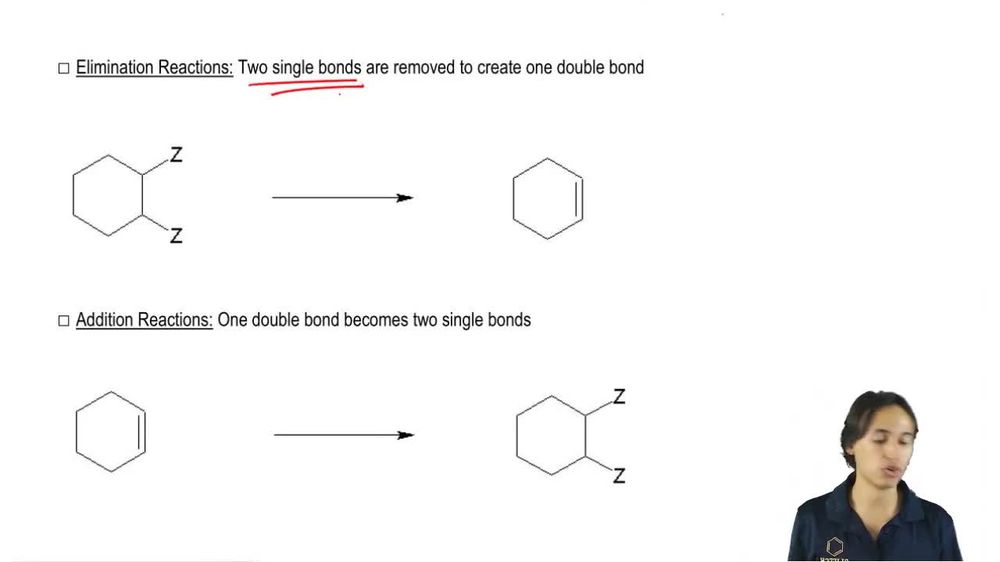
Elimination reactions involve the removal of a leaving group and a hydrogen atom from adjacent carbon atoms, resulting in the formation of a double bond. In this context, the strong base facilitates the elimination of bromine from 2-bromo-2,3-dimethylbutane, leading to the formation of alkenes. Understanding the mechanism of elimination, particularly E2 reactions, is crucial for predicting the products formed.
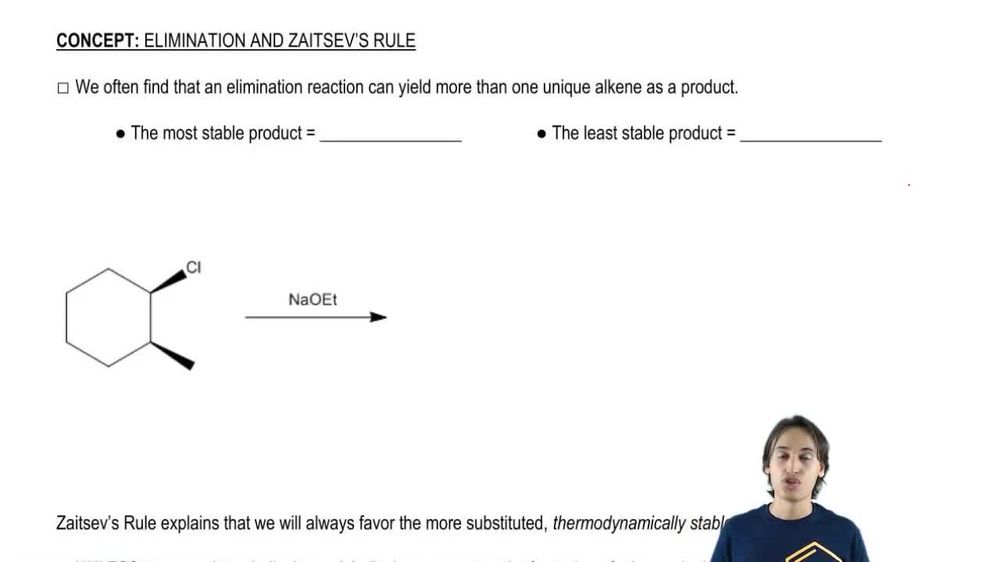
Zaitsev's Rule states that in elimination reactions, the more substituted alkene is generally favored as the major product. This principle helps predict that 2,3-dimethyl-2-butene, being more substituted than 2,3-dimethyl-1-butene, will be the predominant product when a strong base is used. Recognizing the implications of this rule is essential for determining the distribution of alkene products.
Regioselectivity refers to the preference of a chemical reaction to yield one structural isomer over others. In the case of the reaction between 2-bromo-2,3-dimethylbutane and a strong base, understanding which base promotes the formation of either the 1-alkene or the 2-alkene is crucial. Factors such as sterics and the strength of the base influence the regioselectivity of the elimination products.