Free-radical chlorination of hexane gives very poor yields of 1-chlorohexane, while cyclohexane can be converted to chlorocyclohexane in good yield. a. How do you account for this difference? b. What ratio of reactants (cyclohexane and chlorine) would you use for the synthesis of chlorocyclohexane?
Verified step by step guidance
1
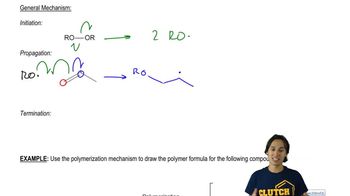
Step 1: Understand the mechanism of free-radical chlorination. Free-radical chlorination involves three steps: initiation, propagation, and termination. The reaction proceeds via the formation of free radicals, and the selectivity of the reaction depends on the stability of the intermediate radicals formed.
Step 2: Analyze part (a). In hexane, free-radical chlorination can occur at multiple positions, leading to a mixture of products. The hydrogen atoms on the primary carbons are less reactive compared to secondary or tertiary carbons, so 1-chlorohexane is formed in poor yield. In contrast, cyclohexane has only one type of hydrogen (all are equivalent), so the reaction leads to a single product, chlorocyclohexane, in good yield.
Step 3: Explain the difference in product distribution. The poor yield of 1-chlorohexane in hexane is due to the lack of selectivity and the competition between primary and secondary hydrogens. Cyclohexane avoids this issue because all hydrogens are equivalent, simplifying the reaction and improving the yield of chlorocyclohexane.
Step 4: Address part (b). To synthesize chlorocyclohexane, it is important to use a controlled ratio of cyclohexane to chlorine. Typically, an excess of cyclohexane is used to minimize the formation of poly-chlorinated products. This ensures that each chlorine molecule reacts with only one cyclohexane molecule, favoring the formation of the mono-chlorinated product.
Step 5: Summarize the approach. For part (a), the difference in yields is due to the selectivity of the reaction and the equivalence of hydrogens in cyclohexane. For part (b), using an excess of cyclohexane relative to chlorine helps achieve a good yield of chlorocyclohexane by limiting over-chlorination.
Verified video answer for a similar problem:
This video solution was recommended by our tutors as helpful for the problem above
Video duration:
10m
Play a video:
0 Comments
Key Concepts
Here are the essential concepts you must grasp in order to answer the question correctly.
Free Radical Mechanism
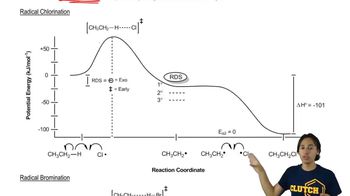
Free radical chlorination involves the formation of free radicals through the homolytic cleavage of the Cl-Cl bond, leading to a chain reaction. In this process, the stability of the resulting radicals significantly influences the reaction's efficiency. Hexane, with its primary and secondary hydrogens, produces less stable radicals compared to cyclohexane, which has more symmetrical and stable secondary radicals, resulting in lower yields for 1-chlorohexane.
The selectivity of chlorination reactions is influenced by the stability of the radicals formed during the reaction. Cyclohexane, due to its ring structure, allows for the formation of more stable secondary radicals, leading to a higher yield of chlorocyclohexane. In contrast, hexane's primary radicals are less stable, making the formation of 1-chlorohexane less favorable and resulting in poor yields.
Using the Hammond Postulate to describe radical chlorination.
Stoichiometry of Reactants
The stoichiometry of reactants in a chlorination reaction is crucial for optimizing yields. For the synthesis of chlorocyclohexane, a typical ratio of cyclohexane to chlorine is 1:1, but excess chlorine may be used to drive the reaction to completion. However, careful control is necessary to avoid over-chlorination, which can lead to multiple substitutions and a mixture of products.