
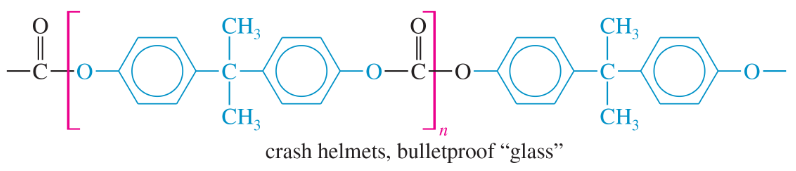
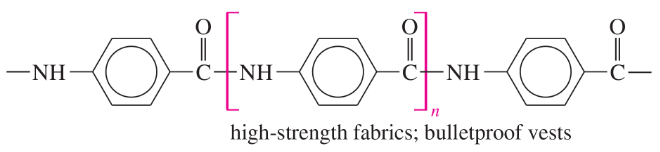
The structures of four useful polymers are shown, together with some of their best-known products. In each case, (i) determine the kind of polymer (polyamide, polyester, etc.). (c) (d)
Verified step by step guidance
1
Step 1: Analyze the first polymer structure (image 1). The repeating unit contains ester functional groups (-COO-) connecting aromatic rings. This indicates that the polymer is a polyester. Polyesters are formed through condensation reactions between diols and dicarboxylic acids.
Step 2: Note the applications of the first polymer, such as crash helmets and bulletproof 'glass'. These applications suggest that the polymer has high strength and durability, which are characteristic properties of polyesters like polycarbonate.
Step 3: Analyze the second polymer structure (image 2). The repeating unit contains amide functional groups (-CONH-) connecting aromatic rings. This indicates that the polymer is a polyamide. Polyamides are formed through condensation reactions between diamines and dicarboxylic acids.
Step 4: Note the applications of the second polymer, such as high-strength fabrics and bulletproof vests. These applications suggest that the polymer has high tensile strength and resistance to impact, which are characteristic properties of polyamides like Kevlar.
Step 5: Summarize the findings: The first polymer is a polyester, likely polycarbonate, used in crash helmets and bulletproof 'glass'. The second polymer is a polyamide, likely Kevlar, used in high-strength fabrics and bulletproof vests.
Verified video answer for a similar problem:
This video solution was recommended by our tutors as helpful for the problem above
Video duration:
2m
Play a video:
0 Comments
Key Concepts
Here are the essential concepts you must grasp in order to answer the question correctly.
Types of Polymers
Polymers can be classified into various types based on their chemical structure and properties. Common categories include polyamides, which contain amide linkages, and polyesters, characterized by ester linkages. Understanding these classifications is essential for identifying the type of polymer in a given structure, as each type has distinct characteristics and applications.
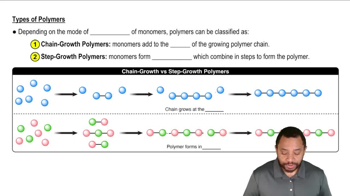
Polymerization is the chemical process through which monomers are chemically bonded to form a polymer. This can occur through addition (chain-growth) or condensation (step-growth) mechanisms. Recognizing the type of polymerization helps in understanding the formation of the polymer's structure and its resultant properties, which are crucial for applications in materials like crash helmets and bulletproof glass.
Different polymers are utilized in various applications based on their mechanical and thermal properties. For instance, polyamides are known for their strength and durability, making them suitable for high-performance fabrics and protective gear. Understanding the relationship between a polymer's structure and its applications is vital for determining its suitability for specific uses, such as in safety equipment.