
Using hex-1-ene as your starting material, show how you would synthesize the following compounds. (Once you have shown how to synthesize a compound, you may use it as the starting material in any later parts of this problem.) a. 1,2-dibromohexane b. hex-1-yne c. 2,2-dibromohexane
Verified step by step guidance
1
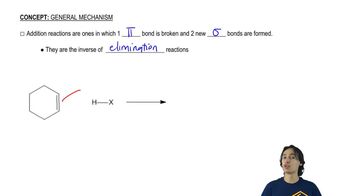
Step 1: To synthesize 1,2-dibromohexane from hex-1-ene, perform an electrophilic addition reaction with bromine (Br₂) in an inert solvent like CCl₄. This reaction adds bromine across the double bond of hex-1-ene, resulting in 1,2-dibromohexane.
Step 2: To synthesize hex-1-yne from hex-1-ene, first convert hex-1-ene into 1,2-dibromohexane using the method described in Step 1. Then, perform a double dehydrohalogenation reaction using a strong base like sodium amide (NaNH₂) in liquid ammonia. This reaction removes two equivalents of HBr, forming the triple bond and yielding hex-1-yne.
Step 3: To synthesize 2,2-dibromohexane from hex-1-ene, first perform a hydrohalogenation reaction with HBr in the presence of peroxides (ROOR). This reaction follows the anti-Markovnikov rule, resulting in the formation of 1-bromohexane.
Step 4: Next, react 1-bromohexane with bromine (Br₂) in the presence of light or heat (a radical bromination reaction). This introduces a bromine atom at the carbon adjacent to the existing bromine, forming 2,2-dibromohexane.
Step 5: Verify the structures of all synthesized compounds to ensure the correct functional groups and positions of substituents are achieved. Use spectroscopic techniques like NMR or IR for confirmation if needed.
Verified video answer for a similar problem:
This video solution was recommended by our tutors as helpful for the problem above
Video duration:
3m
Play a video:
0 Comments
Key Concepts
Here are the essential concepts you must grasp in order to answer the question correctly.
Electrophilic Addition Reactions
Electrophilic addition reactions are fundamental in organic chemistry, particularly for alkenes like hex-1-ene. In these reactions, an electrophile reacts with the double bond of the alkene, leading to the formation of a more saturated compound. For example, adding bromine to hex-1-ene results in 1,2-dibromohexane, showcasing how alkenes can be transformed into haloalkanes.
Alkynes, characterized by a carbon-carbon triple bond, can be synthesized from alkenes through elimination reactions. For instance, converting hex-1-ene to hex-1-yne typically involves a dehydrohalogenation process, where a halogen and a hydrogen atom are removed from adjacent carbon atoms. Understanding this transformation is crucial for synthesizing compounds with triple bonds.
Rearrangement reactions involve the reorganization of atoms within a molecule to form a new structure, often leading to more stable configurations. In the case of synthesizing 2,2-dibromohexane, a rearrangement may occur after the initial addition of bromine to hex-1-ene, allowing for the formation of a more substituted and stable product. Recognizing these pathways is essential for predicting the outcomes of synthetic routes.