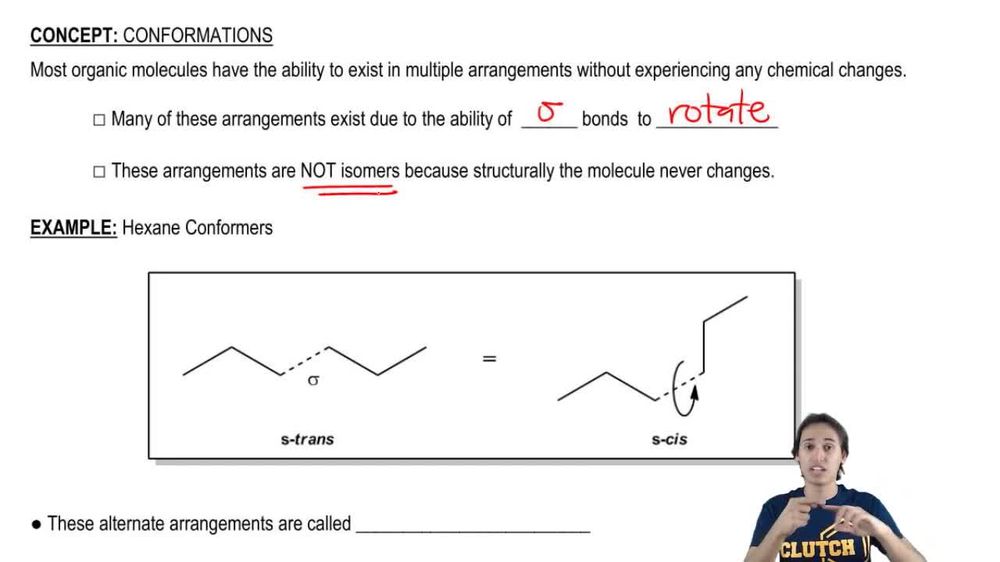
Given the following structures, show the Newman projection that would result from looking down the indicated bond in the direction shown. [Orient yourself as if you were the eyeball looking down the bond. Some of the examples have been partially completed for you to fill in the rest.] (i) <IMAGE>
Verified step by step guidance
1
Orient yourself as the 'eyeball' looking directly down the indicated bond. Identify the front carbon (closest to the eye) and the back carbon (furthest from the eye) along the bond axis.
Draw a circle to represent the back carbon atom. The front carbon atom will be represented by a dot in the center of the circle.
Identify the three substituents attached to the front carbon. Arrange them as lines radiating outward from the central dot, spaced at 120° angles. Ensure their positions match the 3D structure of the molecule.
Identify the three substituents attached to the back carbon. Arrange them as lines radiating outward from the edge of the circle, spaced at 120° angles. Ensure their positions match the 3D structure of the molecule.
Double-check the relative positions of all substituents to ensure the Newman projection accurately represents the stereochemistry of the molecule as viewed down the bond.
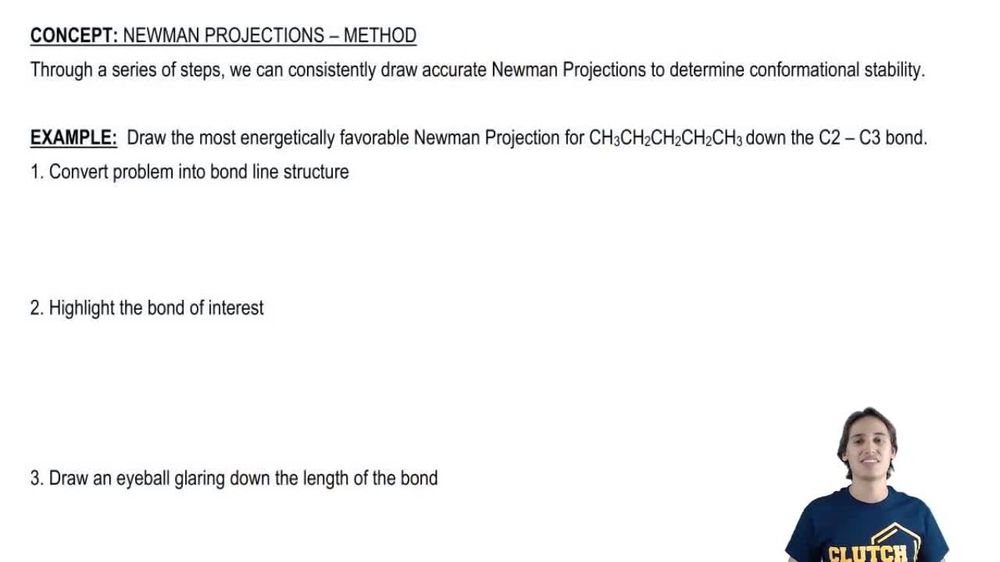
Verified video answer for a similar problem:
This video solution was recommended by our tutors as helpful for the problem above
Video duration:
2m
Play a video:
0 Comments
Key Concepts
Here are the essential concepts you must grasp in order to answer the question correctly.
Newman Projections
Newman projections are a way to visualize the conformation of a molecule by looking straight down a bond between two carbon atoms. This representation helps in understanding the spatial arrangement of substituents attached to the carbons, allowing for the analysis of steric interactions and torsional strain in different conformations.
Conformational analysis involves studying the different spatial arrangements of atoms in a molecule that can be interconverted by rotation around single bonds. This analysis is crucial for predicting the stability of various conformers, as certain arrangements may lead to increased steric hindrance or torsional strain, affecting the molecule's reactivity and properties.
Steric hindrance refers to the repulsion between atoms or groups within a molecule that occurs when they are brought close together. In the context of Newman projections, understanding steric hindrance is essential for evaluating the stability of different conformations, as bulky groups can create unfavorable interactions that influence the preferred conformation of the molecule.